


The Economic Structure of Digital Advertising Platforms
Modern digital advertising platforms such as Google Ads, TikTok Ads, Meta Ads, or LinkedIn function at their core as high-frequency, automated auction houses. Every time users submit a search query, load a social media feed, or visit a webpage with integrated ad slots, a real-time auction is initiated in fractions of a millisecond to award the available ad inventory to the highest bidder and most relevant player.
However, this technological basis harbors a fundamental economic truth from the gambling industry: In the end, the house always wins.
The operators of advertising platforms control the technological infrastructure and the rules of the game for these marketplaces and continuously optimize their systems to extract maximum revenue from the limited ad inventory. In an increasingly saturated market environment where a growing number of advertisers compete for the same target groups and search terms, this auction principle inevitably leads to a continuous upward spiral of Cost-per-Click (CPC) and Cost-per-Acquisition (CPA).
Intense competition drives prices up without the real value of the acquired visibility increasing proportionally. As a result, advertisers find themselves in progressive margin erosion: While the profits of platform operators grow due to the constantly increasing bidding volume, the profitability margins of advertising companies shrink under the pressure of rising acquisition costs.
In theory, assuming that companies in direct competition have a similar cost structure, everyone in an auction house system optimizes until there is no margin left. For strategic reasons, this may pay off in the short term, but it is not economically viable in the long term. Even if one company manages to reduce costs, competitors must inevitably follow suit, and the system settles back into equilibrium.
Functionality and Systematics of Modern Advertising Auctions
To understand the dynamics of this price spiral, an analysis of the underlying auction mechanisms is required. Historically, the digital advertising market was based primarily on the principle of the Second-Price Auction, as established, for example, in the classic Generalized Second Price (GSP) model of Google Ads or historically in Google AdSense. In this model, the winner of the auction does not pay their actual maximum bid, but merely the amount of the second-highest bid plus one cent to maintain their position. This system was intended to give advertisers the security to submit bids close to their actual willingness to pay without fearing immediate overpayment.
In recent years, however, the programmatic advertising world has undergone a significant transformation toward the First-Price Auction. Google has implemented this transition for both video and display inventory within Google Ad Manager and for Google AdSense. In the First-Price Auction system, the highest bidder pays exactly the price they bid. Although this change increases transparency, as hidden fees from ad exchanges or sell-side platforms (SSPs) are eliminated and the actual value of an ad slot becomes more clearly quantifiable, it simultaneously increases pressure on advertising budgets. To prevent systematic overpayment in first-price auctions, buyers use bid-shading algorithms, which attempt to predict the fair market value of an impression based on historical data and competitive factors and adjust the bid downward accordingly.
Meta Ads uses a similar, highly complex valuation process that undergoes a four-stage filtering (Retrieval, Light Ranking, Heavy Ranking, and final auction) within a time window of about 200 milliseconds. The final allocation of an impression is based on maximizing the “Total Value”:
The “Estimated Action Rate” predicts the probability of a conversion based on over 500 behavioral signals, while the “Consumer Value” evaluates creative ad quality, user feedback, and the post-click experience on the website. Both platforms thus show that excellent creative and technical implementation can compensate for bidding costs, as highly relevant ads are preferred with lower click rates.
Auction Models in Digital Marketing
Comparison & Systematics by Auction Mechanisms, Pricing & Quality Factors
| Parameter | Google Search(GSP Model) | Meta Ads(Total Value Model) | ProgrammaticDisplay Market |
|---|---|---|---|
| Auction Mechanism | Modified Second-Price Auction(Ad Rank driven) | Real-Time User Value Auction(Total Value) | Predominantly First-Price Auction(First-Price) |
| Clearing Price | Next-highest Ad Rank / Own Quality Score + €0.01 |
Dynamically optimized based on bidding strategy & Target CPA |
Exact submitted bid(Clearing Price) |
| Quality Factor | Scale from 1 to 10(CTR, Relevance, Landing Page) | User Relevance, Ad Quality, Landing Page Load Time |
Publisher-specific Price Floors |
| Optimization Focus | Search Intent & Keyword Relevance |
User Behavior, Visual Quality, Entertainment Factor |
Efficient Remnant Monetization & Audience Targeting |
Systemic Drivers of Click-Price Inflation in the Period 2025 to 2026
The drastic increase in advertising costs in the period from 2025 to 2026 is not a temporary market phenomenon, but the result of profound structural shifts within digital advertising ecosystems. Cross-industry data from 2025 show that almost 87% of all industries recorded significant increases in click prices, with the average CPC across all industries reaching a historic high of a respectable $5.26. In individual highly competitive sectors such as B2B and the SaaS area, this inflation accelerated further in 2026 with an additional annual growth of up to 9%.
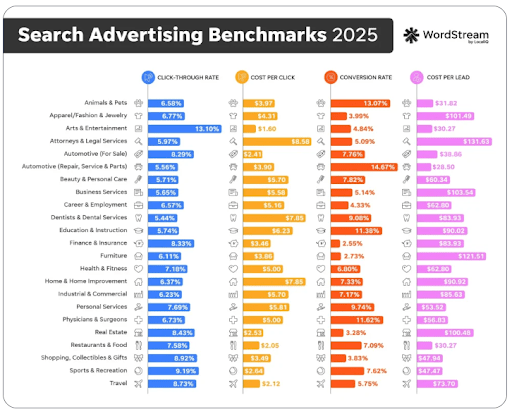
This price increase is driven by four interconnected factors:
1. Disruption of Search Results Pages by AI Overviews
The progressive integration of Google’s artificial intelligence into search results pages (AI Overviews) has fundamentally changed the structure of search results. AI Overviews occupy prominent space above classic search results, significantly pushing down traditional organic listings and paid ads.
This leads to a drastic shortage of directly visible ad inventory (Above-the-Fold).
Empirical surveys by Seer Interactive show that the click-through rate on paid ads for search queries that trigger an AI summary drops by a dramatic 68% – from previously 19.7% to only 6.34%. Since fewer clicks are generated on the same area, a more intense battle for the remaining premium placements ignites among advertisers, which massively drives up bids.
2. Performance Max and Cross-Channel Auction Pressure
Performance Max campaigns (PMax), which now control 35% to 45% of the total Google Ads volume, have dissolved the boundaries between advertising channels.
Instead of managing separate budgets for search, shopping, YouTube, or the display network, the AI of PMax automatically optimizes the budget across all Google networks. This creates a new form of internal and external auction pressure.
A PMax campaign optimized for broad conversion goals simultaneously bids on keywords also targeted by classic search or standard shopping campaigns. Algorithms outbid themselves in real time, driving up CPCs.
3. The Automated Bidding Cycle of Smart Bidding
Google, TikTok, and Meta rely almost entirely on automated bidding strategies designed primarily to maximize conversions or adhere to a target CPA. Since the algorithms of all market participants are based on similar mathematical optimization models, they compete aggressively for the same high-quality user segments. When the AI predicts a high purchase probability, the bidding systems of all competing advertisers increase their bids simultaneously. This leads to an artificial, algorithmic price inflation that systematically pushes the entry price for valuable target groups upward.
4. E-Commerce CPC Dynamics and the Phenomenon of Artificial Scarcity
In the e-commerce sector, a clear anomaly is visible in the period 2025–2026.
While general CPC inflation is flattening slightly year-on-year – for example, growth in shopping CPCs slowed from about 16% in Q3 2025 to 6% in Q2 2026 – absolute costs remain at an extremely high level.
The cause may lie in Google’s strategic preference for PMax formats on the search results page. This artificially creates a scarcity of remaining ad inventory for standard shopping campaigns, which causes CPCs to rise massively for advertisers relying on manual control.
| Market Indicator | Historical Value (up to 2024) |
Current Value (2025–2026) |
Trend and Predicted Development |
|---|---|---|---|
| Cross-Industry Google Ads CPC |
~$3.50 to $4.20 | $5.26 / £5.2610 | Further increase of 5% to 9% in the B2B and SaaS segment. |
| Paid CTR on SERPs with AI Overviews |
~19.7% | 6.34%10 | Stabilization at a low level; focus shifts to transactional niches. |
| PMax Conversion Share |
~22% (2024)21 | 35% to 45% (2026)21 |
Full market penetration; standard shopping becomes a niche product. |
| Shopping CPC YoY Inflation |
+16% (Q3 2025)24 | +6% (Q2 2026)24 | Consolidation of advertising budgets due to stricter ROAS specifications. |
The Risk of Pure Performance Dependency
Advertisers who invest nearly 100% of their marketing budget in short-term performance channels and neglect long-term brand building are maneuvering themselves into a life-threatening strategic dead end.
Performance marketing extracts existing demand highly efficiently, but does not generate new demand itself. This operational imbalance is like a fisherman who fishes a lake intensively without ever providing for new fish stock: sooner or later, the pond is empty, and the effort for each remaining fish increases exponentially.
In practice, this one-sidedness leads to Customer Acquisition Costs (CAC) rising uncontrollably within 18 to 24 months, as the pool of easily convertible users is exhausted. Without the protective foundation of a known brand, the product remains interchangeable in the auction. Advertisers are forced to compete solely on price or through ever-higher bids, which systematically destroys the profit margin.
Additionally, the fragmentation of search exacerbates this dependency. Consumers are increasingly using alternative platforms such as TikTok, Instagram, or AI assistants for information gathering.
At the same time, informational search queries (“What is” questions) are shifting directly to search platforms (AI Overviews, ChatGPT, etc.) due to AI summaries, causing classic informational web traffic to largely dry up. Anyone who does not have an independent brand presence that generates direct, unpaid inquiries remains defenseless against the algorithmic price dictates of large networks.
The Symbiosis of Brand Building and Performance Activation
The only effective long-term strategy against exploding acquisition costs is a balanced marketing mix that uses organic visibility, brand building (Brand Building), and sales activation (Performance Marketing) as complementary forces.
Empirical studies by marketing researchers Les Binet and Peter Field prove that the accumulation of individual short-term performance campaigns cannot generate real brand growth or sustainable brand capital (Brand Equity) in the long term.
Their analysis of over 900 IPA campaigns shows: A budget allocation of 60% for long-term brand building and 40% for short-term sales activation achieves the highest economic total efficiency (Profit Gain) over both short and long periods.
Source: Brand vs. Performance Marketing: Why Marketers Need Both – Core Creative
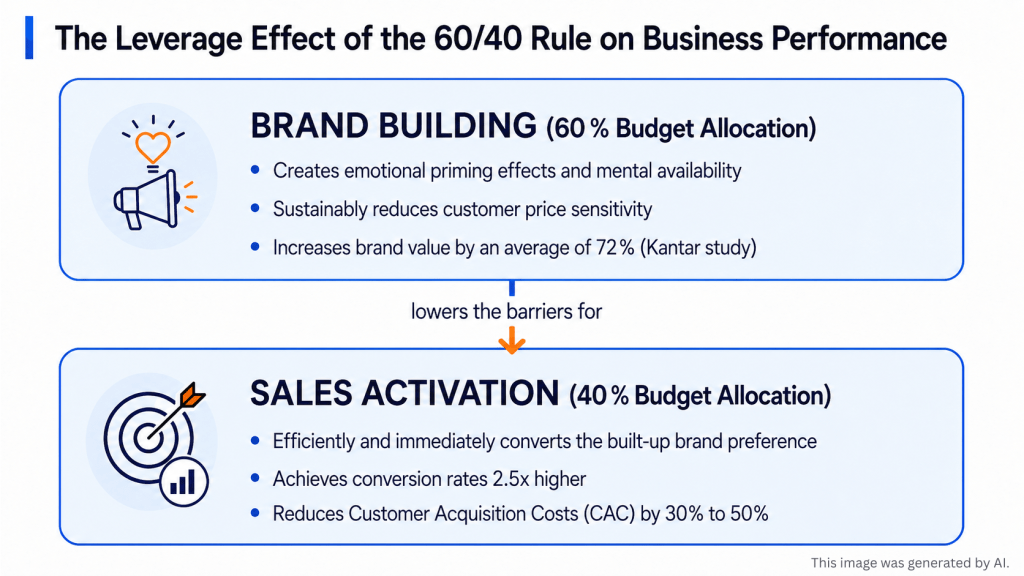
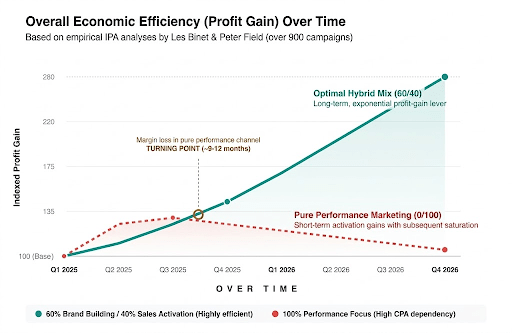
This hybrid approach unfolds a direct mathematical effect in the advertising auctions. Established brands benefit from significantly higher click-through rates (CTR), as users instinctively give preference to trusted providers in the search results and social feeds. In the auction system of Google Ads, a higher CTR directly improves the Quality Score.
Since the Quality Score is used as a divisor in the calculation of the actual click price, known brands systematically pay less for the same ad position than unknown competitors.
Operational Levers for Curbing the Price Spiral
To effectively counter the rising cost of performance traffic, advertisers must move beyond purely reactive bidding and implement proactive, data-driven control mechanisms. This requires a solid data basis and a MarTech Stack. Experience shows: Unregulated transfer of bidding sovereignty to bidding algorithms leads to creeping, unintentional budget inflation.
The following operational levers counteract this dynamic:
1. Holistic Success Measurement via Marketing Mix Modeling (MMM)
Since traditional multi-touch attribution models provide increasingly inaccurate data in a cookieless advertising world, Marketing Mix Modeling (MMM) is gaining massive importance as a strategic steering tool. MMM uses aggregated, privacy-compliant data over longer periods to mathematically decompose the actual impact of all marketing activities on business results (revenue, leads).
This statistical approach is ideally validated through regular incrementality tests. Here, teams specifically switch off ads for a geographically delimited user group to determine how many conversions were generated purely incrementally by the advertising and how many would have occurred organically anyway.
2. Optimization according to Customer Lifetime Value (CLV)
Instead of rigidly optimizing campaigns for first-purchase revenue, advertisers should establish the Customer Lifetime Value as the primary target metric. A strong brand ensures that customers remain loyal in the long term, make repeat direct purchases, and thus do not have to be acquired again via expensive performance auctions for every subsequent transaction.
3. Establishment of a Future-Proof Customer-Agent Interface
Kantar forecasts the broad establishment of autonomous AI shopping assistants (AI Agents) for the year 2026, which perform purchase decisions on behalf of consumers. Around 24% of AI users are already accessing such assistants today.
Brands must therefore ensure that their product data, service details, and brand content are machine-readable and easily searchable for these non-human consumers, while simultaneously maintaining emotional appeal for the human decision-maker in the background.
| Operational Lever | Core Mechanism | Primary Benefit | Risks and Limitations |
|---|---|---|---|
| Max Bid Limits (3x Cap) | Strict capping of extreme click prices at the campaign level. | Immediate elimination of budget waste in outlier auctions. | Minimal restriction of algorithmic flexibility during seasonal peaks. |
| Active Cost Control (1.5x–2.5x) | Tighter bidding corridors to actively reduce the average CPC. | Effective dampening of CPC inflation during competitive market phases. | Risk of exclusion from highly converting premium auctions. |
| Marketing Mix Modeling (MMM) | Statistical regression analysis on aggregated data streams. | Holistic, privacy-compliant budget control across all channels. | Requires high-quality historical time series data and statistical expertise. |
| Incrementality Tests | Controlled geo-testing scenarios with ad holdouts. | Precise determination of the real, incremental value contribution of an ad channel. | Temporary sacrifice of ad revenue in the control region during the testing phase. |
Strategic Action Recommendations for Modern Marketing Management
To sustainably secure corporate value creation and the operating margin, marketing management should implement the following strategic guidelines:
Move away from silo thinking and implement the hybrid mix: The strict separation between brand and performance teams must be abolished in favor of an integrated overall strategy. Budgets should be allocated based on the 60/40 rule to continuously build new demand through emotional brand management, while performance systems perform activation at the bottom of the funnel highly efficiently.
“It takes more real cross-disciplinary growth teams from product, tech, data, AI, and marketing.”
Systematic campaign hygiene and segmentation: Ad accounts must be structured strictly according to strategic intention. Mixing generic keywords for new customer acquisition with high-converting brand keywords within automated campaigns distorts the data basis of the algorithms and artificially drives up bid prices.
Systematic campaign hygiene and segmentation: Given the advancing loss of signals due to data protection regulations, companies must build their own customer data stocks. The direct integration of CRM data via server-side tracking (Conversions API) ensures that the platforms’ AI systems are fed with precise conversion data, which shortens learning phases and drastically increases bidding efficiency.
Focus on content diversification and relevance: As classic information pages lose reach, the focus of content must lie on highly commercial, transactional, and expert-based content (E-E-A-T framework). A seamless transition from the search intention through the ad to a fast, mobile-optimized landing page improves the Quality Score and directly lowers the actual click costs in the auction.
Through this holistic transformation, companies develop from passive bidders who guarantee platform operators constantly increasing profits into sovereign market participants. A strong brand combined with precise operational campaign management ensures that the economic return on marketing investments remains where it belongs: in the company itself.