

The marketing landscape is facing its biggest structural shift since the advent of search engines. Users are no longer just searching for links. Instead, they are asking questions of large language models (LLMs) such as ChatGPT, Gemini, Claude, or Perplexity and receiving direct answers.
This shift is leading to a phenomenon that is unsettling many marketing teams: falling click-through rates in traditional organic search traffic. Studies show that AI responses and Google AI Overviews can reduce the organic click-through rate (CTR) by 15 per cent and, in some cases, by over 35 per cent.
Does this mean that fewer people are engaging with your content? Not necessarily. Today, they are simply consuming brand content directly within the AI platforms. To capitalise profitably on this new customer touchpoint and justify investment in Generative AI Optimisation (GAIO) or Answer Engine Optimisation (AEO), traditional SEO tracking is no longer sufficient.
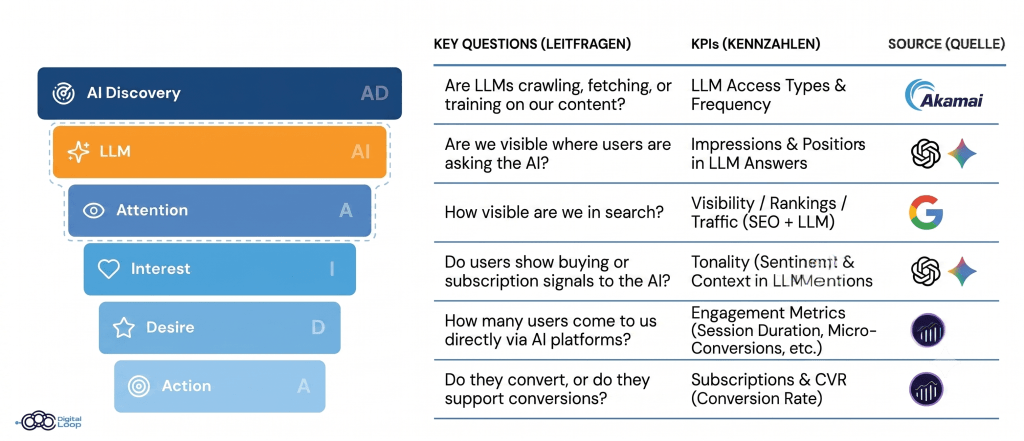
Here at Digital Loop, we have expanded the existing marketing funnel model to address this: the AD-AIDA framework. In this guide, we’ll show you, step by step, how to use this model to precisely measure and optimise the ROI of your GAIO activities.
What Is the AD-AIDA Framework?
The classic AIDA model (Attention, Interest, Desire, Action) is based on the assumption that a user’s first touchpoint with your brand takes place on your website or in your advert. In the AI era, however, touchpoints begin much earlier, long before anyone even visits your domain.
The AD-AIDA framework adds two crucial technical layers to the classic funnel:
AD | AI Discovery | Crawling, indexing & on-demand fetches |
LLM | Visibility & rankings in AI responses | |
A | Attention | Reach via search engines & LLMs |
I | Interest | User intent, context & sentiment |
D | Desire | Direct engagement & micro-conversions |
A | Action | Conversions, purchases & subscriptions |
The 3 Levels of GAIO Measurement In the AD-AIDA Model
To provide comprehensive evidence of the ROI of AEO and GAIO, we divide the measurement into three interlinked levels.
Level 1: AI Discovery (Server & CDN Level)
Before an AI can recommend your content, it must read and understand it. At this stage, we measure traffic from bots and AI agents.
AI agents access your website for three main reasons:
- Model training: AI crawlers collect public data for future model updates (e.g. GPTBot, ClaudeBot).
- Search indexing: Crawlers build their own search indexes for AI search functions (e.g. OAI-SearchBot, PerplexityBot).
- On-demand fetching: The AI assistant accesses a URL in real time to answer a specific user query (e.g. ChatGPT users, Perplexity users).
How to Measure Layer 1:
Using server log files or log analyses at CDN level (e.g. Cloudflare AI Crawl Control or Adobe LLM Optimizer), you can filter specifically for relevant user agents:
Provider | User-Agent-Muster | Function |
OpenAI | GPTBot | Training crawler for models |
OpenAI | OAI-SearchBot | Indexing bot for ChatGPT Search |
OpenAI | ChatGPT-User | Live access upon direct user request |
Perplexity | PerplexityBot/1.0 | Indexing for AI search |
Perplexity | Perplexity-User/1.0 | Live fetch upon user interaction |
Anthropic | ClaudeBot | Training & collection bot |
Key KPIs at Level 1:
- LLM Access Frequency: Access frequency broken down by provider and bot type
- Path-Level Crawl Volume: Volume of requests for specific commercial and transactional content paths
- Fetch ratio: Ratio between automated background indexing and user-driven live fetches
Level 2: In-LLM Visibility & Attention (Model Level)
At this stage, we no longer measure machine visits, but rather the human-visible presence in the responses generated by AI systems.
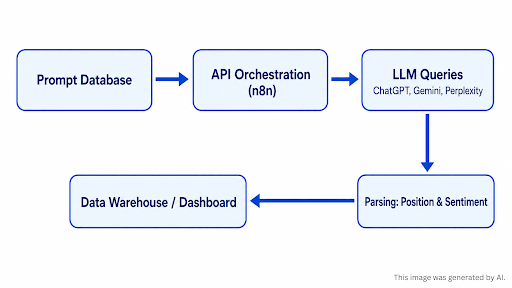
As LLMs do not provide direct Search Console data, we systematically simulate typical user prompts via APIs and automated pipelines (e.g. via n8n or Make):
- Define prompt set: Create dynamic prompt matrices tailored to your business model (e.g. B2B: “Best CRM software for manufacturing companies” or e-commerce: “Best coffee machines for the home”).
- Automated queries: Send these prompts regularly to ChatGPT, Gemini, Perplexity and Google AI Overviews.
- Parsing & analysis: Automatically evaluate the responses for brand mentions, quotes and links.
Key KPIs at Level 2:
- Brand Mentions / In-LLM Impressions: The frequency with which your brand or product is explicitly mentioned in AI responses
- Average Rank in Synthesis: Your brand’s positioning within generated recommendation lists
- Share of Model Voice (SoMV): The percentage share of mentions of your brand compared directly to the competition
- Sentiment & Context Score: Contextualisation and tone of the mention (e.g. as an innovation leader or best value for money)
- Citation Rate & Link Density: Proportion of generated source links that point directly to your landing pages
Level 3: On-Site Performance & Conversions (AIDA Level)
As soon as a user clicks through to your website from an AI response, established web analytics methods in Google Analytics 4 or Adobe Analytics come into play.
Users who arrive at your website via AI platforms are often characterised by an extremely high purchase intent. They have already completed the information and evaluation phase within the AI and land directly on product or service pages.
How to Identify LLM Traffic in Analytics:
- ChatGPT: Visits usually appear as a referral via chatgpt.com / chat.openai.com or with appended UTM parameters (utm_source=chatgpt.com).
- Perplexity: Shows reliable referrers such as perplexity.ai or www.perplexity.ai.
- Google AI Overviews: These are categorised under the standard ‘Organic’ channel (google / organic). Potential AI Overview clicks can often be identified in JavaScript via text fragment anchors in the URL (#:~:text=…).
- Claude: Referrals appear as claude.ai / referral.
Key KPIs at Level 3:
- LLM referral volume: Absolute number of qualified website visits from AI platforms
- Qualified engagement rate: Session duration, scroll depth and interactions with digital touchpoints
- Conversion rate (CVR) delta: Performance comparison between LLM referrals and traditional organic traffic
- Time to First Purchase: Time taken to convert for target audiences from AI sources
How to Calculate GAIO ROI
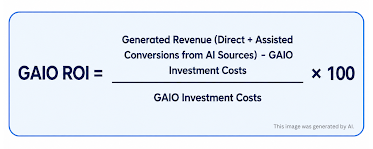
The AD-AIDA framework allows the return on investment (ROI) for Generative AI Optimisation to be quantified mathematically:
Cost Components (Investment):
- Creation of high-quality, more structured content (focus on commercial and transactional intents).
- Technical adjustments to the web infrastructure (crawler accessibility, schema markup).
- Monitoring tools and API costs for automated in-LLM measurements.
The Revenue Components (Value):
- Direct revenue: Conversions from visitors referred by AI (chatgpt.com, perplexity.ai, etc.).
- Assisted conversions: Users who became aware of the brand via an AI recommendation and later converted either directly or via brand search.
- Saved customer acquisition costs (CAC):
Relevance in AI responses secures organic business that would otherwise have to be acquired at great expense via performance marketing (SEA/Ads).
Conclusion: From Speculation to Data-Driven Decisions
The absence of clicks due to AI responses does not represent a loss of market share. It is a shift in the point of first contact with the brand.
Anyone who uses GAIO in isolation and focuses solely on traditional click figures will draw the wrong conclusions.
With the AD-AIDA measurement framework, you can combine technical AI discovery with in-LLM visibility and actual revenue figures on your website. This allows you to transform vague assumptions about AI trends into a clear, verifiable business case.
Would You Like to Systematically Measure Your Brand’s AI Visibility?
We’ll build the digital products and measurement systems you need to set up GAIO monitoring, structure your server logs, and make LLM traffic visible in your analytics systems. Get in touch with us to set up a bespoke GAIO audit for your systems!