


The transformation of digital commerce is reaching a new stage of evolution: The transition from visually driven, human-centered web interfaces to autonomous, AI-driven ecosystems is unfolding with high momentum: Agentic Commerce.
The previously dominant human-to-computer interaction is gradually being complemented by an agent-to-agent (A2A) economy in which software acts as an autonomous consumption and decision-making entity. As a result, our focus in marketing is shifting fundamentally: away from appealing visually and emotionally to human website visitors toward providing highly structured, machine-readable, and semantically consistent data spaces. These must be optimized so that AI models can interpret them without error and select them preferentially.
Agentic Commerce Analytics in this context does not describe a functional extension of classic digital analytics, but rather establishes an independent and practically grounded discipline. While the first wave of artificial intelligence in e-commerce was characterized by passive recommendation systems and simple chatbots, agentic systems are distinguished by functional autonomy, multi-step action logic (reasoning), and cross-platform interoperability.
For marketing managers, this shift changes the fundamental target system (e.g., marketing control and performance management).
Differentiation and Paradigm Shift: Classic Digital Analytics versus Agentic Analytics
The transition from classic digital marketing analytics to agentic commerce analytics requires a revision of established measurement and analysis paradigms. Classic systems rely on client-side browser tracking, session metrics, page views, and linear funnel views. Agentic analytics, on the other hand, operates more strongly in a server-side, data-driven environment in which interactions take place decorrelation-wise via APIs and conversational interfaces—often without the merchant’s traditional website even being visited.
Dimension | Digital Analytics | Agentic Commerce Analytics |
Target Group | Human users / Browser visitors | Autonomous AI Agents & LLM Crawlers (A2A) |
Touchpoint | Own websites, mobile apps, visual UIs | Chat interfaces, APIs, search layers, voice |
Data Collection | Client-side pixels, cookies, DOM events | Server-side webhooks, APIs, protocol logs |
At the center of this analytical structural shift is the so-called attribution crisis. When consumers initiate purchases via AI assistants such as ChatGPT, Perplexity, or Google AI Mode, data exchange occurs directly between AI platforms and merchant APIs. Client-side tracking pixels do not fire in this scenario. While a traditional browser checkout generates over 40 specific data points (including referrer, dwell time, click paths, and cart events), an agentic API checkout often yields only around 6 server-side primary data points such as order ID, transaction value, delivery address, and timestamp.
This circumstance creates a critical data gap in established marketing attribution models. Without the use of server-side collection systems, these revenues are misattributed in standard analytics suites as unassignable “Direct” traffic or “(not set)”, leading to misallocations of marketing budgets.
As a result of these shifts, the operational division of roles within marketing and data teams is also changing. The classic hierarchy of report creators and manual analysts is transforming into a functional structure that may look as follows:
- AI Data Engineer (Human): Develops the semantic data layer, ensures proper markup of product data (e.g., Schema.org, JSON-LD), and maintains the API infrastructure so that AI agents can access catalog data without friction.
- Analytics Agent (AI Agent): Takes over continuous monitoring of key performance indicators, performs AI-supported root cause analyses for metric anomalies, and triggers automated reports and alerts.
- Business Decision Maker (Human): Interprets strategic signals from AI agents, manages experiments, and takes responsibility for overall performance and brand positioning alignment.
Excursus: Client vs. Server Side Tracking
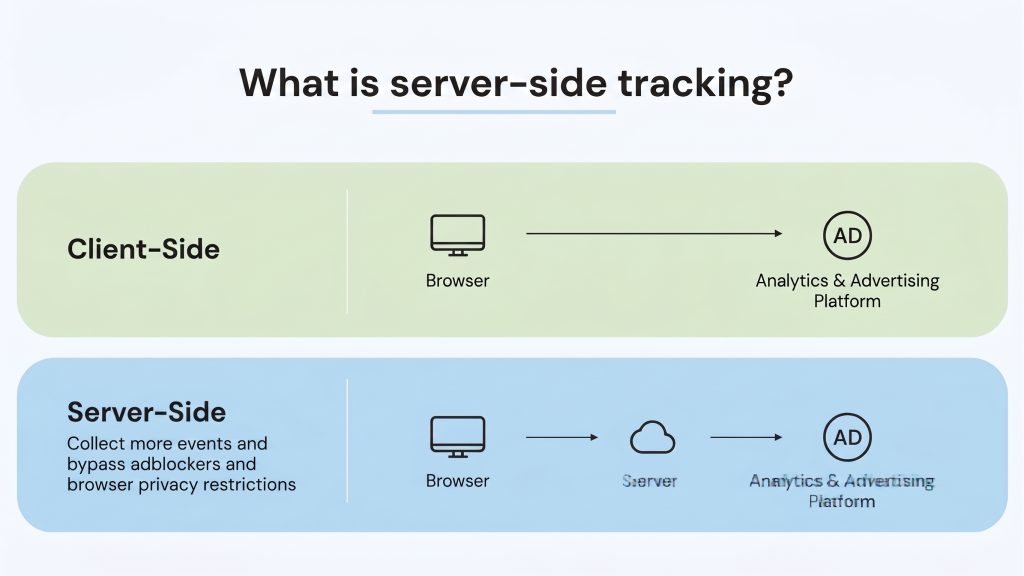
The main difference between Client-Side and Server-Side Tracking lies in where the data processing occurs. In classic Client-Side Tracking, pixels in the browser capture user interactions and send them directly to third-party servers. Data privacy regulations, ad blockers, and browserless AI agents increasingly limit this method. In contrast, Server-Side Tracking shifts the process to a dedicated server: Data is transmitted from the client or backend, validated and enriched there, and then forwarded to analytics platforms. This provides greater control over data quality, closes attribution gaps for API purchases, and is more resilient against client-side restrictions.
Technological Architecture, Protocols, and Tool Landscape
The technical feasibility of Agentic Commerce Analytics relies on standardized communication protocols that act as a shared language (“rules of engagement”) between AI models, merchant systems, and payment service providers. These standards define how product data is queried, carts are generated, identities are verified, and payment tokens are securely exchanged.
Protocol / Standard | Initiators & Supporters | Architecture Model | Strategic Application Scope |
Model Context Protocol (MCP) | Anthropic, Open-Source (including Shopify, commercetools) | Open context standard for LLM tools | Dynamically connects AI models to external data sources, APIs, and databases for context enrichment. |
Agentic Commerce Protocol (ACP) | OpenAI & Stripe | Platform & marketplace model | Focuses on direct instant checkout and delegated payments within GenAI interfaces like ChatGPT. |
Universal Commerce Protocol (UCP) | Google & Shopify (including Walmart, Target, Visa) | Open web standard (Open Web Model) | Standardizes the entire purchasing cycle from discovery to cart creation to post-purchase tracking for Google AI Mode & Gemini. |
To close the attribution gap created by agentic purchases, a reconfiguration of the analytics architecture is necessary. Client-side tracking is supplemented by server-side event transmission. For example, via the GA4 Measurement Protocol and Server-Side Google Tag Manager (GTM), or in the Tealium ecosystem EventStream, transaction data is transmitted directly from e-commerce backend systems (such as Shopify, Shopware, WooCommerce, or SAP Commerce) to analytics platforms via server-side webhooks.
Behavioral Analysis of AI Agents and Dialogue Flow Measurement
In-depth behavioral analysis of autonomous AI agents requires the continuous tracking and evaluation of complex interaction patterns throughout the entire decision-making process. Unlike rigid click-tracking on the web, agentic behavioral analysis focuses on making model reasoning paths, tool calling, and decision boundaries transparent. Analysts evaluate how purposefully an agent navigates, where confidence drops or context drift occurs, and which parameters lead to a transaction being completed successfully or abandoned prematurely. Automated classification and topic clustering across thousands of model traces allow systematic misbehavior, hallucinations, or hidden drop-off reasons to be identified in real time.
A key component of agentic behavioral measurement is the empirical evaluation of intent recognition, fallback rates, and confidence scores during the reasoning chain. When consumer or purchasing agents compare alternative offers, the system analyzes whether the agent enters unintended fallback loops or stops due to a lack of relevant data in the system. The quantitative evaluation of these “agentic drop-offs” and the comparison of target versus actual behavior enable marketers and analytics engineers to refine both their own data infrastructures (e.g., RAG contexts and API interfaces) and interaction logic in a targeted manner.
To systematically measure the dynamics of multi-turn conversational flows, specialized methodological approaches and analytics tools have been established:
Methodological Approach | Description & Analytical Purpose | Relevant Tools & Platforms |
Agent Execution & Trace Analysis | Visualization and reconstruction of decision graphs, tool calls, and context windows for individual dialogue steps. | Langfuse, LangSmith, HoneyHive |
Intent & Fallback Flow Analytics | Measurement of user intents, identification of exit points (“default fallbacks”), and analysis of confidence scores across the dialogue flow. | Google Dialogflow CX Analytics, EVO Dynamics, Rasa Studio |
Conversation Topic Clustering & Trend Analytics | Automated summarization and clustering of thousands of dialogues into topic groups for early detection of recurring patterns. | Braintrust (Topics), Galileo (Luna-2), Datadog LLM Observability |
Semantic Layer & Governed Conversational Querying | Securing dialogue flows through a predefined semantic layer for accurate data queries and structured dialogue management. | Cube, ThoughtSpot, Decagon AI |
The New KPI Framework for Agentic Marketing
Measuring marketing success in agentic commerce requires both familiar KPIs adapted for the new “AI marketing channel” as well as entirely new metrics.
KPI Category | Metric | Definition & Calculation Basis | Strategic Importance |
Outcome & Revenue | AI Revenue Percentage | Monetary revenue generated via AI channels divided by total revenue in the measurement period. | Determines the commercial relevance and growth dynamics of the agentic sales channel. |
Agent Conversion Rate | Number of successfully completed agent transactions divided by total agent interactions. | Measures the technical and content efficiency of machine-readable checkout. | |
Average Order Value (AOV) by Channel | Average order value of purchases initiated or executed by AI agents. | Highlights differences in purchasing behavior between human and machine shoppers. | |
Visibility & Citation | AI Citation Rate / Visibility | Frequency with which own brand or products are cited in LLM response sets (e.g., Perplexity, ChatGPT). | Replaces traditional organic search rankings within Agent-Oriented Optimization (AOO). |
Recommendation Eligibility | Share of catalog products whose structured data satisfies completeness criteria of AI models. | Indicator of accessibility and processability of the product range by LLMs. | |
Platform Coverage | Number of AI platforms (e.g., ChatGPT, Gemini, Copilot) actively indexing and recommending the merchant’s assortment. | Measures infrastructural reach across the distributed AI search landscape. | |
Data Quality & Tech | Semantic Clarity & Consistency | Validation rate of product data against defined Schema.org and JSON-LD standards. | Prevents product exclusion by AI agents due to ambiguous attributes. |
API Response Time / Latency | Response time of inventory and pricing endpoints to external agent requests (Target: < 200 ms). | Critical threshold; slow APIs result in abandoned agent searches. | |
Agent Interaction Cost | Incurred infrastructure and token costs per processed agent transaction. | Monitors economic efficiency when serving real-time data to AI systems. |
A key strategic advantage of agentic analytics lies in leveraging signals from the consideration phase. Because consumers formulate highly specific, context-rich search queries to AI agents (e.g., “Find a running shoe with cushioning for flat feet under 120 euros with delivery by Friday”), aggregated prompts yield direct insights into unmet customer needs. Long-tail search queries with five or more words show significant growth rates and provide a rich data foundation for product development and content alignment.
The economic efficiency of agentic channels is demonstrated in comparative conversion measurements: While the global average for organic website visits remains in the low single digits, ChatGPT-referred visits achieve conversion rates of 15.9% (compared to 1.76% for traditional Google organic search). Furthermore, early adopters of the Universal Commerce Protocol (UCP) report a 28% higher conversion rate compared to traditional search channels, as pre-qualification of users takes place via the AI agent prior to the actual transaction.
Conclusion and Strategic Recommendations
Agentic Commerce Analytics represents a structural turning point in digital marketing. The shift from purely visual influence over human users to providing machine-readable decision data requires a realignment of analytical processes. Shifting transactions into conversational interfaces and protocol layers undermines traditional client-side tracking methods, making the construction of server-side infrastructures imperative.
From these analytical findings, three key recommendations emerge for marketing leaders:
- Establishing Machine Discoverability (Data Excellence): Product data, pricing, inventory, and promotional logic must be provided consistently, fully, and in a structured format via Schema.org and standardized protocols (UCP, ACP, MCP). Without these foundations, products will remain invisible in the search and decision-making processes of autonomous AI agents.
- Closing the Attribution Gap via Server-Side Tracking: To avoid “dark traffic” blind spots in performance measurement, the analytics infrastructure must be expanded with server-side collection methods such as the GA4 Measurement Protocol. This is the only way session-less API purchases can be accurately assigned to their respective AI channels.
- Leveraging Consideration Data for Brand Positioning: Quantitative and qualitative data streams from AI interactions provide deep insights into consumers’ actual decision and comparison criteria. Systematically evaluating these signals allows for precise adjustments to product portfolios and secures brand salience in a commerce environment dominated by AI agents.