


For the past twenty years, the “Search” button has been the undisputed gatekeeper of the digital economy. We mastered keywords, built backlinks, and optimized for human eyes scanning a list of blue links. But we are now entering the B2AI era (Business-to-AI), where the interface is shifting from search to action, and the “user” is increasingly an autonomous AI agent.
The transition from Search Engine Optimization (SEO) to Agent-Oriented Optimization (AOO) represents a fundamental change in how brands stay visible.
The Evolution: From Rules to Agents
To understand where we are going, we must look at how far we’ve come. The journey from 20th-century computing to Agentic AI has moved through distinct layers:
- Rule-based Systems: Fixed, deterministic logic.
- Machine Learning: Predicting values and recognizing patterns from data.
- Deep Learning: Leveraging multi-layer neural networks for complex tasks.
- Generative AI: Using transformer models to create new content variants.
- AI Agents: Systems that understand context, plan intelligently, and execute tasks autonomously.
While Generative AI (like early ChatGPT) focused on giving answers, Agentic AI focuses on outcomes. It doesn’t just tell you which flight is best; it plans the trip, checks your calendar, and books the seat.
The New Marketing Funnel: The “Action” Layer
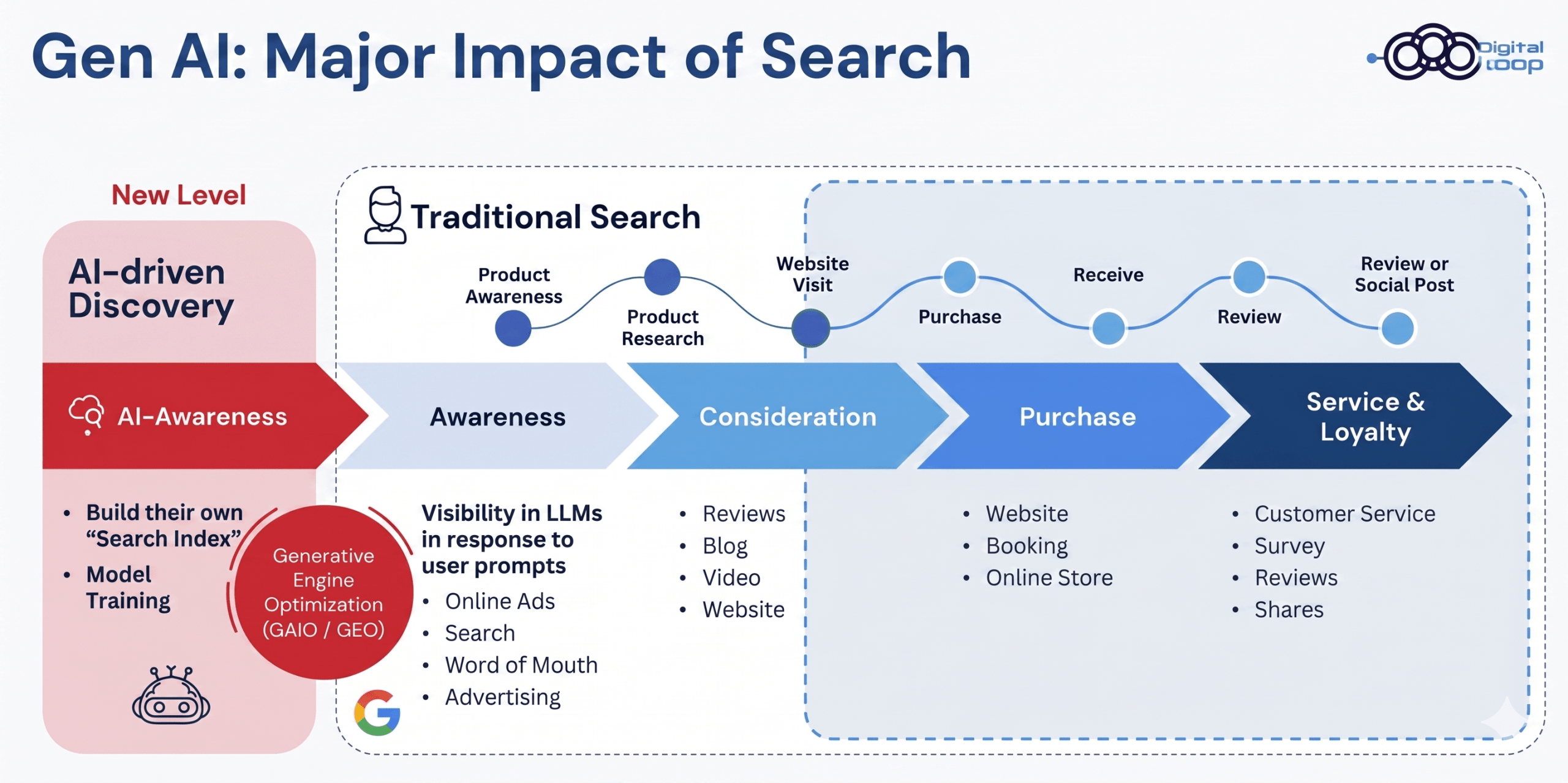
The traditional marketing funnel—Awareness, Consideration, Purchase, Service—is being overlaid with a new, proactive layer. In the old world, a user might click through five comparison sites. In the agentic world, the agent navigates, filters, and transacts on the user’s behalf.
The Shift in User Intent
- Search (Yesterday): Humans formulate keywords (e.g., “best hiking boots 2024”).
- Answer (Today): Models condense content, citing sources, and reducing friction.
- Action (Tomorrow): Agents plan steps, fetch data, and orchestrate tools to complete a goal.
The best customer experience will no longer end at the “click,” but at the completed task. If your brand isn’t “readable” by an agent, you effectively don’t exist in their decision-making loop.
What is AOO (Agent-Oriented Optimization)?
If SEO was about visibility for humans, AOO is about executability for agents. It is the discipline of ensuring your brand’s “objects”, i.e. your products, locations, FAQs, and policies, are structured so that AI agents can recognize, compare, and use them in a workflow.
SEO vs. AOO: A Comparison
Feature | SEO (Today) | AOO (Tomorrow) |
Goal | Visibility for humans via search engines | Executability for autonomous AI agents |
Audience | Human users with search intent | AI Agents acting on a user’s behalf |
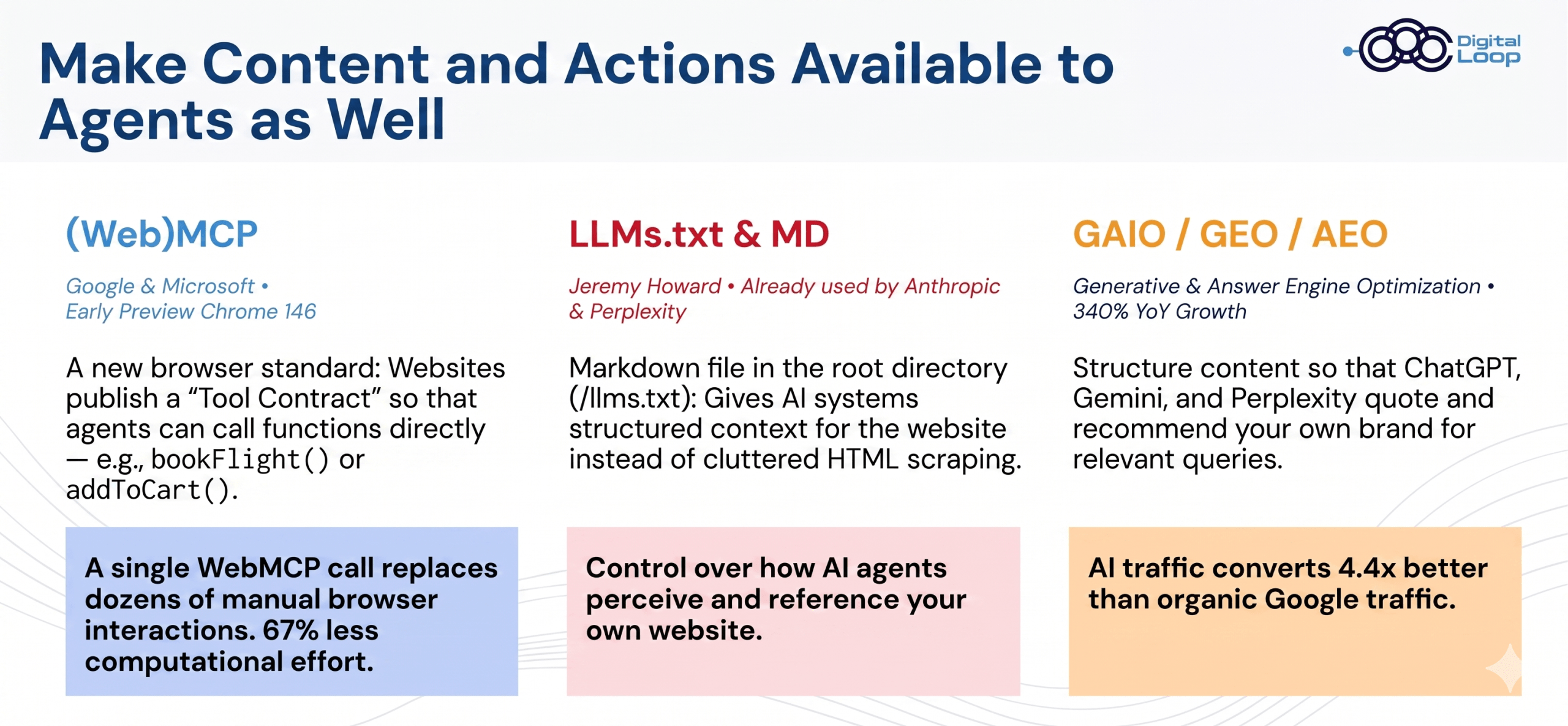
Techniques | Keywords, meta-tags, backlinks | JSON-LD, APIs, LLMs.txt, WebMCP |
Interaction | Passive (user clicks, site responds) | Proactive (agent navigates and buys) |
Metrics | Rankings and clicks | AI citations and agent-initiated conversions |
The Architecture of Trust: The AOO Pyramid
This framework isn’t a one-time update, but rather a structural hierarchy that builds trust between your brand and the AI:
- Identity: Clear entities, authors, and product attributes.
- Knowledge: Original, helpful, and highly-citable documentation.
- Structure: Semantically rich HTML, Schema.org, and dedicated feeds.
- Actions: The “hands” of the agent—APIs, tool contracts, and checkout flows.
- Trust: Governance, monitoring, and accountability.
The AOO Virtuous Cycle
Implementing AOO creates a competitive flywheel. When you optimize your website with WebMCP and structured data, agents perform better and deliver more accurate results. This increases user trust, leading them to delegate more decisions to their agents. Eventually, competition is forced to follow, but early adopters will have already secured their place as the “preferred tool” for the most popular agents.
AOO in Practice: Industry Use Cases
How does this look in the real world of 2026?
- E-Commerce: Instead of a user filtering for “size 42 blue sneakers,” an agent queries your inventory tool directly via an API, checks the return policy, and presents a “buy now” confirmation to the user.
- Travel: An agent searches, filters, and books a hotel in a single step using WebMCP, bypassing the need for a human to navigate five different tabs.
- Customer Support: An agent automatically fills out a support ticket by pulling diagnostic logs and account IDs from the browser context, solving the problem before the user even types a word.
5 Strategic Priorities for Marketers
As we move toward a world where McKinsey predicts over 60% of additional AI value will come from agentic applications, here is how you should prepare:
- Audit AI Visibility: Use tools like Semrush AI Visibility or Perplexity to see who is being cited for your top keywords.
- Create a Technical Foundation: Implement an llms.txt file and configure bot access (GPTBot, ClaudeBot).
- Optimize for “BLUF”: Use the Bottom Line Up Front approach. Place concrete numbers and answers at the very top of your pages for easy LLM parsing.
- Define Tool Contracts: Make your website “agent-ready” by structuring forms and checkouts for machine interaction.
- Track New KPIs: Stop obsessing over clicks. Start measuring AI Share of Voice and Agent-Initiated Conversions.
Conclusion: The Era of “Action Optimization”
We are no longer just “consulting”; we are building. The B2AI era demands that we move from “click optimization” to “action optimization.”
At Digital Loop, we don’t just recommend these tools—we implement them. We act as the interdisciplinary translators between your strategy and the emerging tech stack of 2026. Brands that become the preferred choice for AI agents today will own the market for the next decade.
The window is open, the interest is high, but the execution is still rare. Will your brand be found, or will it be executed?