


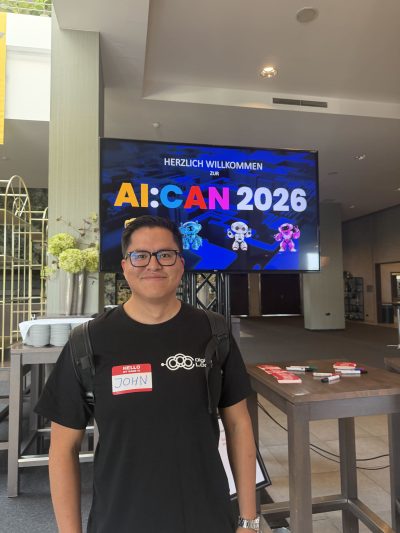
I just got back from the AI:CAN conference in Berlin, and if you are currently navigating the sea of enterprise AI hype, I have one clear piece of advice: get your tickets for next year.
As a practitioner, I love walking out of a room with notes that immediately turn into experiments. Here is my breakdown of the most impactful insights from the event, through the lens of a Marketing Technology Company.
1. Process Mapping Trumps Automation Hype
A common trap I see enterprise teams fall into is trying to automate a workflow they don’t actually understand yet. They look at tools like n8n as magic wands.
During his session, Hans Jung reinforced a fundamental rule: AI does not fix broken operations; it simply accelerates them. Technical mastery means nothing without rigorous process design. Before you write a single line of automation code or connect an API, you must map the manual logic step by step. If your core workflow is messy, your automated output will just be cleanly delivered chaos.
2. Dynamic SEO, Content, and the Power of "URL Context"
The landscape of search intent is shifting rapidly. With the rise of AI Overviews, traditional informational keyword scaling is hitting a wall. Matthias Hotz delivered a fantastic look at what is currently possible when you combine advanced AI with programmatic SEO and content architectures.
One specific takeaway that stood out to me was the concept of URL Context. Think of it like giving the AI a clear map: by keeping your URL structures logical and organized, search engines and AI models can instantly understand how your pages relate to each other—even across massive websites. It’s an elegant reminder that high-impact SEO isn’t about generating more text—it’s about optimizing data accessibility for machines.
3. The Barriers to Multimedia Production are gone
We talk a lot about content democratization, but seeing it live is a different story. The technical barriers to creating rich media have completely evaporated.
- Visual Storytelling: Georg Neumann showcased how far AI-multimedia tools have come. He walked through a framework so intuitive that I am already using his guide to build a personalized illustrated picture book for my daughter.
- Rapid Video Workflows: Roland Golla demonstrated the absolute extreme of production speed. During a casual chat about a specific topic, he managed to spin up, finalize, and publish a fully formed YouTube video within minutes.
For marketing leaders, this means production speed is no longer a differentiator. When everyone can produce high-quality video and design instantly, the only true competitive edge is the substance of your message.
4. Deep Technical Mastery and Peer Exchange
The best part of an event like this is the informal exchange between sessions. Reconnecting and trading notes with industry peers like Markus Amalaraj and Joachim Nickel is invaluable for validating what is actually working in production versus what looks good on a presentation slide.
I also have to highlight Markus Baersch. In our industry, it is incredibly rare to find professionals who look past marketing interfaces and dive deep into the underlying technical architecture of data tracking. His session provided a masterclass in the engineering reality behind modern analytics tools.
From Dashboards to Dialogues: My Perspective
I also had the pleasure of stepping on stage to present my talk, “Von Dashboards zu Dialogen” (From Dashboards to Dialogues).
My core argument is simple: enterprise companies are drowning in fragmented analytics data. For simple Q&As and routine marketing queries, out-of-the-box Model Context Protocols (MCPs) from tool providers are an excellent starting point. They get you up and running fast.
But standard setups hit a wall when queries grow complex. When you need to link fragmented data sources, integrate internal proprietary data, or pre-calculate business logic, you face a completely different challenge. Creating a robust semantic layer with strict quality gates requires a deeper, tailored architecture.
By connecting your data architecture with semantic frameworks, we can transition from passive monitoring to active dialogue. Imagine asking your data warehouse direct, conversational questions and receiving a verified, context-aware insight backed by real-time analytics. That is where the relationship between marketing and technology becomes a genuine growth driver.
Next Steps: Moving from Slide Decks to Code
Marco Janck and his team put together a format that skips the theoretical fluff and cuts straight to what matters: real execution, live tool tracking, and practical constraints. From n8n and Claude workflows to deep technical dives, it provided exactly what marketing and tech leaders need right now: blueprint clarity over abstract promises.
If AI:CAN proved anything, it’s that the market moves too fast for long discovery phases. Unfortunately, I didn’t have enough time to catch every single session, but the overarching takeaway is clear: stop treating AI as a future strategy and start implementing it as a daily operational standard.