

Imagine you’ve spent years building up a loyal audience on Facebook, Instagram or LinkedIn. You’ve invested substantial budgets, optimised your content and seen engagement rates rise. Then one morning, the platform changes its algorithm… and your organic reach plummets.
This is exactly the scenario experienced by the website Retro Dodo: following a single Google Core Update, the platform lost around 85 per cent of its organic traffic–and the associated revenue–overnight. It wasn’t that anyone there had suddenly started doing a poor job. It was simply a painful realisation of their dependence on a platform that doesn’t belong to them.
Here at Digital Loop, we know that this risk affects almost every business. It’s time to escape the digital rental trap and reclaim your data sovereignty.
With advertising, you’re buying that first click.
With a genuine brand, you build up a loyal customer base who come back of their own accord.
The MarTech Trap: What Are ‘Rented Audiences’ Really?
In modern marketing, we often see one key mistake: treating every form of digital reach as an asset in its own right. In reality, most channels are rented audiences: a borrowed target audience.
- You cannot contact your social media audiences directly; the algorithm decides who sees your posts.
- Your search engine rankings exist only at the discretion of the operators.
- Paid adverts guarantee visibility only as long as you continue to pay the ever-rising cost per click.
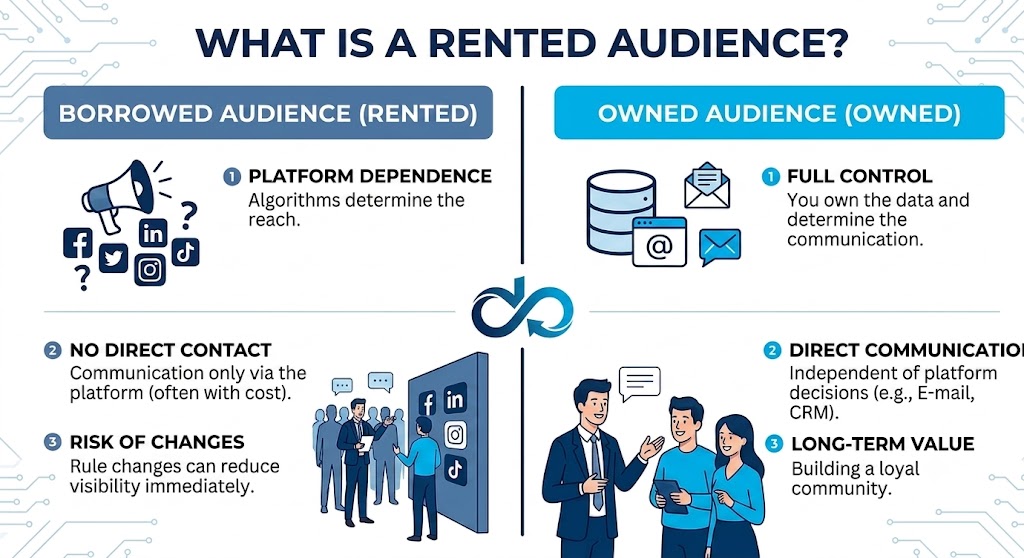 Source: Digital Loop – Gemini
Businesses are subject to algorithms and auction models. Organic reach on the major platforms has been falling inexorably for years. Whilst Facebook posts still reached around 16 per cent of a page’s followers in 2012, this figure is now often just under 1 per cent.
Organic reach on LinkedIn also saw a 34 per cent slump between 2024 and 2025. A large number of followers does not protect you from becoming invisible when the platforms raise the ‘rent’ for attention.
The Collapse of Traditional Tracking Using Cookies and Similar
The conditions for external audience targeting are deteriorating rapidly.
Although Google has, for the time being, reversed its decision to phase out third-party cookies in the Chrome browser, privacy-first browsers such as Safari, Firefox and Brave block cross-site tracking by default anyway.
This means that 20% to 25% of total web traffic is already lost for traditional retargeting.
Furthermore, regulatory requirements such as the GDPR are increasing the pressure. In Europe, on average, only 45% of users now give their consent to tracking – in privacy-conscious markets such as Germany and France, the opt-in rate is even below 25%.
At the same time, artificial intelligence is emerging as a new intermediary between your content and your readers. Already, 68% of all Google search queries end without a single click (zero-click searches) because AI summaries and AI overviews provide the answers directly on the results page.
If users no longer leave the search results page, the traditional, click-based marketing model collapses.
First-Party Data With AI: Building Your Own Target Audience Intelligently
The only sustainable response to these developments is an uncompromising focus on first-party data. Those who own their target audience’s contact details and behavioural data are independent of algorithms and platforms.
An in-house email list or a verified customer database retains its value… permanently. On average, email marketing achieves a return on investment (ROI) of around €36 for every euro invested.
Messaging channels such as WhatsApp, chatbots, and push notifications have also proven to be valuable channels.
However, simply collecting data is not enough in enterprise environments. Without structure, large volumes of data quickly lead to fragmented silos, where marketing, IT, and analytics speak different languages. It is only by linking first-party data with AI that unstructured data points are transformed into strategic competitive advantages.
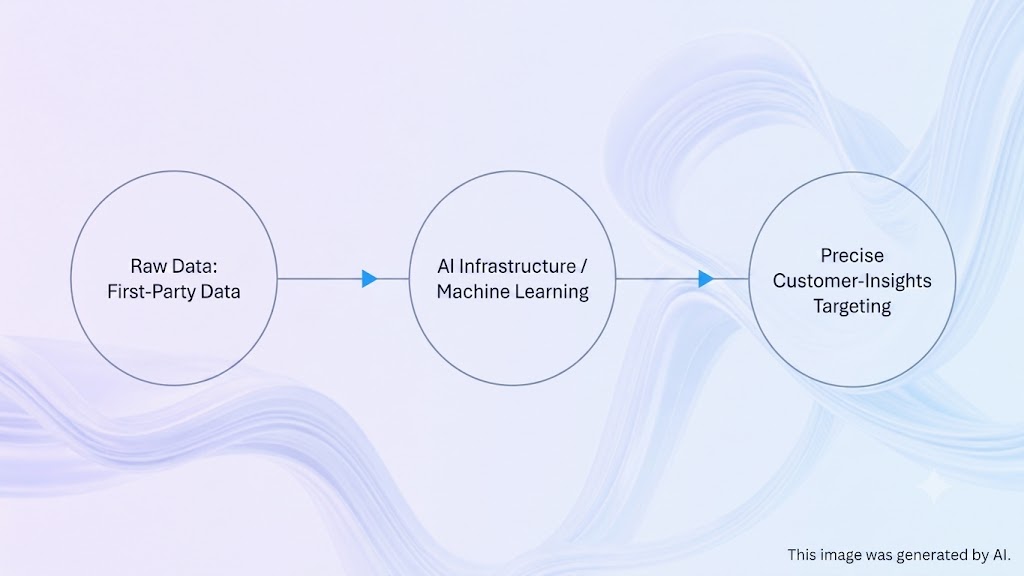
Artificial intelligence enables us to analyse complex behavioural patterns across millions of URLs and customer profiles in real time. Instead of rigid, manually created segments, modern systems use machine learning models to dynamically interpret customer journeys:
- Predictive analytics: AI models calculate precise churn scores to retain customers at risk of churn in good time with automated, exclusive offers.
- Next-Best-Offer (NBO) strategies: Algorithms use historical data and real-time signals to pinpoint exactly which product is the next most relevant for a specific profile.
- Scaled relevance: Machine learning automates the semantic analysis and internal linking of complex platforms to uncover high-quality conversion paths.
- AI personas: Synthetic personas and target groups that simulate ‘real’ users.
Rented vs. Owned: A Strategic Comparison
Criterion | Borrowed Target Audience (Rented) | Own Target Audience with AI (Owned) |
Data Sovereignty | Lies completely with the respective platform | Lies 100% with your own company |
Reach Control | Dependent on algorithms and ad budgets | Direct and unfiltered steerable |
Tracking Stability | Prone to cookie bans and browser blocks | Stable, as it is based on direct customer interactions |
Targeting Precision | Generic platform segments | Personalization through machine learning |
Long-term Value | Sinks due to rising advertising costs and Customer Acquisition Costs (CAC) | Increases and behaves like a real corporate asset |
From a Scattergun Approach to Genuine Customer Targeting
According to studies by Google and the Boston Consulting Group, companies that consistently base their marketing strategy on first-party data report up to 2.9 times higher turnover and 1.5 times greater cost savings than competitors who do not.
Making the transition requires a shift in mindset: continue to use your existing reach on platforms such as Google or LinkedIn as a gateway to new contacts – but don’t let the customer journey end there. Systematically convert paid attention into your own relationships by inviting users to interact directly with your brand, subscribe to channels, or use your own platforms.
With a clean database and integrated AI systems, you can automate this process, reduce your customer acquisition costs (CAC), and build an agile marketing infrastructure that is immune to future platform updates.
Conclusion
The shift from rented reach to data-driven independence is one of the key challenges facing modern marketing teams. We must become the architects of our own systems today before we can expect true autonomy.
If this post has helped you better understand the risks of Rented Audiences, please share the article within your network on LinkedIn or Twitter to drive the discussion on the future of MarTech infrastructure.