


Let me guess. You opened your favorite SEO tool, exported 50.000 keywords, stared at the spreadsheet, and thought: “Yes, this is totally manageable.” Maybe you even added a pivot table for emotional support. Classic move.
At a small scale, SEO feels almost… reasonable. You check rankings, fix a few pages, optimize some titles, and maybe write content that people actually want to read. You can still pretend you are in control.
Then enterprise happens…
Suddenly, you are dealing with millions of URLs, dozens of markets, multiple CMS setups, and a content team that publishes faster than you can open your crawler. Your “quick audit” turns into a multi-week archaeological dig through logs, reports, and dashboards that all politely disagree with each other.
Traditional SEO tools were not designed for this level of chaos. They are great at telling you what already happened. Your traffic dropped. Your rankings changed. Your Core Web Vitals are… let’s say “character building.” All useful, but also slightly too late to be helpful.
Manual analysis does not scale either. You cannot realistically review thousands of pages, identify patterns, prioritize actions, and still have time left to explain it all in a meeting where someone asks if we can “just fix SEO quickly.”
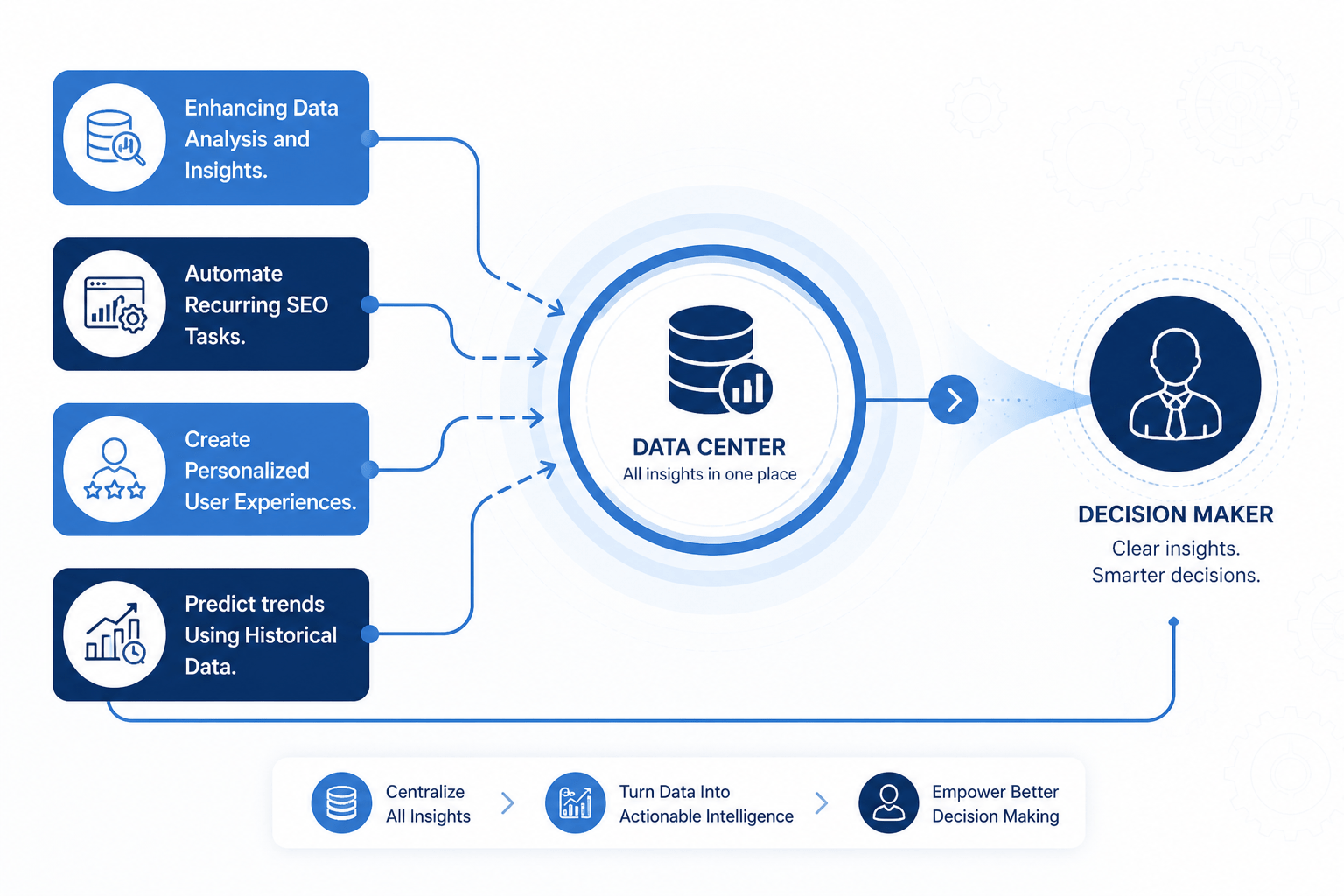
Instead of just describing the past, enterprise SEO needs to move toward predicting what will happen next and prescribing what to do about it. Not just “this page lost traffic,” but “this section will lose traffic in three weeks unless you fix these specific issues.” Not just “these keywords are declining,” but “these topics are emerging, and here is where you should invest before your competitors notice.”
This image was generated by AI.
And this is exactly where machine learning quietly enters the room. Not as some magical black box that replaces SEO (that would be too easy). Instead, it acts as the only thing capable of making sense of enterprise-level complexity. It can process patterns across millions of data points, detect anomalies before they become disasters, and surface insights that no human with a spreadsheet ever asked for but definitely needed.
In other words, machine learning does not make SEO simpler. It just makes it possible at an enterprise scale.
What Machine Learning Means in the Context of SEO (No Buzzwords)
Let’s clear something up before we accidentally reinvent a conference keynote.
Machine learning in SEO is not a mystical force that “optimizes everything automatically.” If it were, you would not be reading this.
In reality, machine learning is just a way of finding patterns in data at a scale where humans politely give up.
Most enterprise SEO teams already use automation. Scripts, rules, alerts, dashboards. If X happens, do Y. If traffic drops by 20 percent, send a Slack message that everyone ignores for three hours. That is rules-based automation, and it works well when the problem is predictable and clearly defined.
The issue is that enterprise SEO problems are rarely that polite.
You are not dealing with one rule. You are dealing with thousands of variables interacting at the same time. Rankings shift because of content, internal linking, page speed, intent mismatch, SERP features, and whatever Google decided to experiment with last Tuesday.
You cannot write a rule for every possible combination. You would need infinite time and a very forgiving team.
Machine learning skips that whole mess. Instead of telling the system what to look for, you give it data and let it figure out patterns on its own. It does not ask for rules. It builds them.
Supervised vs Unsupervised Learning Without the Academic Headache
Now we get to the part where people usually start drawing diagrams. Let’s not do that.
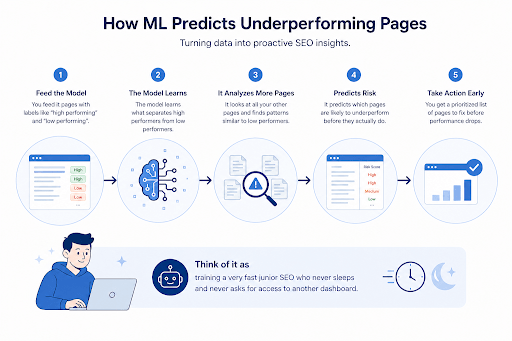
Supervised learning is simple. You show the model examples and tell it what the correct answer is.
In SEO terms:
This image was generated by AI.
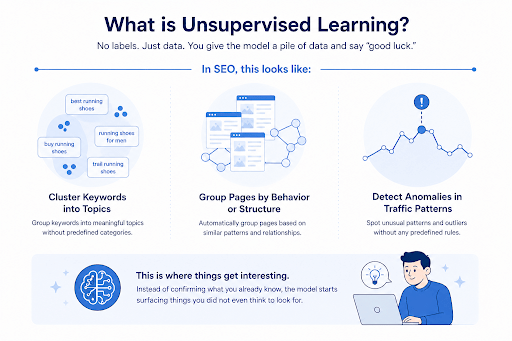
Unsupervised learning is what happens when you do not provide labels. You just give the model a pile of data and say, “Good luck.”
In SEO, this looks like:
This image was generated by AI.
Key SEO Challenges Enterprise Websites Face
Fragmented Data Across SEO, Analytics, UX, and Content Teams
If enterprise SEO had a main villain, it would be data fragmentation.
Your SEO data lives in one tool. Your analytics in another. UX metrics somewhere else. Content performance in a completely different system. Everyone has dashboards. Nobody has the same numbers.
You ask a simple question like “Why did traffic drop?” and suddenly you are in a cross-team meeting where each department presents a different version of reality.
- SEO says rankings declined
- Analytics says sessions are stable
- UX says engagement dropped
- Content says everything is fine
At this point, you are not optimizing a website. You are reconciling alternate universes. The real problem is not a lack of data: It is too much data that does not talk to each other.
Delayed Insights and Reactive Optimization Cycles
Enterprise SEO is famously “fast”. By which I mean it reacts to things that already happened three weeks ago.
You notice a traffic drop. You investigate. You identify the issue. You prioritize a fix. You get it into a sprint. It gets implemented. Then you wait for it to be crawled, indexed, and reflected in rankings.
By the time you confirm the impact, the original problem feels like a historical event.
This creates a cycle where most decisions are reactive. You are constantly responding to past performance instead of shaping future outcomes–which is great only if your goal is to always be one step behind.
Inconsistent Content Quality and Intent Alignment
Now let’s talk about content. Or more specifically, the chaos of content at scale.
When you have hundreds of contributors, multiple markets, and different guidelines that may or may not be followed, consistency becomes optional.
Some pages are excellent. Some are outdated. Some were clearly written for a completely different intent, but somehow still rank. Others exist purely because “we needed a page for that keyword.” Intent alignment suffers the most.
You think a page targets one thing. Users expect another. Search engines interpret something in between. The result is content that technically exists, but does not fully satisfy anyone involved. And when this happens across thousands of pages, it is no longer a content issue. It is a systemic problem.
Core Areas Where Machine Learning Delivers SEO Insights
This is the part where machine learning finally stops being a buzzword and starts doing actual work.
Search Intent Classification at Scale
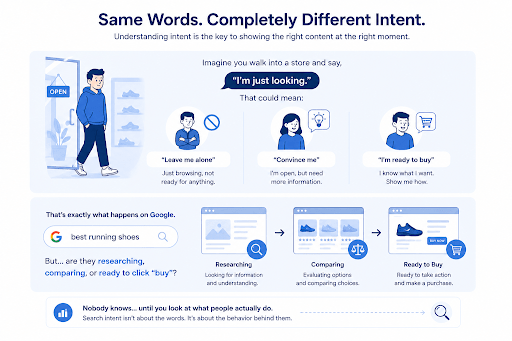
Well, let’s talk about search intent:
This image was generated by AI.
Search intent sounds simple until you try to map it across hundreds of thousands of keywords.
Manually grouping keywords is cute at a small scale. At enterprise scale, it turns into a never-ending tagging exercise where consistency slowly disappears, and everyone invents their own version of “informational.”
Machine learning handles this by clustering keywords and pages based on how they actually behave, not how you think they should behave.
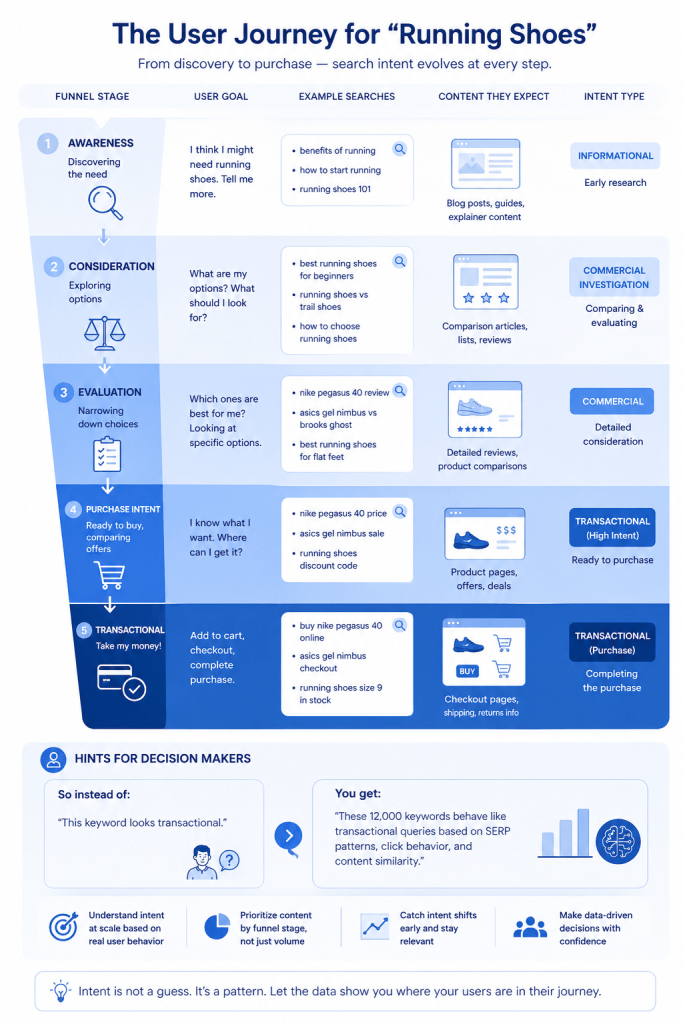
So instead of:
“This keyword looks transactional.”
You get:
“These 12,000 keywords behave like transactional queries based on SERP patterns, click behavior, and content similarity.”
Which is slightly more convincing. Right?
It also detects when intent shifts over time. Because yes, users change their minds. What used to be informational can suddenly become commercial, and your perfectly optimized page is now perfectly irrelevant.
This feeds directly into funnel-based SEO. You can prioritize content not just by volume, but by where it sits in the user journey. Awareness, consideration, decision… All those slides you presented suddenly have actual data behind them.
This image was generated by AI.
Content Quality and Relevance Scoring
Enterprise content is a mix of brilliance, mediocrity, and things nobody wants to admit exist.
The challenge is not knowing that low-quality content exists. The challenge is finding it without manually opening 20.000 pages and questioning your career choices.
Machine learning can score content based on patterns:
- Pages that are thin
- Pages that are redundant
- Pages that are outdated but still somehow indexed
It can also evaluate topical depth. Not in a vague “this feels comprehensive” way, but by analyzing entity coverage and semantic relationships. In other words, it understands whether your page actually covers a topic or just politely mentions it a few times.
The real value comes from prioritization.
Not all content updates are equal. Some changes will move the needle. Others will do absolutely nothing but make you feel productive. Machine learning helps you focus on pages where updates are likely to have an impact, not just pages that are easy to fix.
Predictive Traffic and Ranking Forecasts
Forecasting in SEO has traditionally been… optimistic.
You take current rankings, apply some assumptions, maybe multiply by expected CTR, and present a number that looks reasonable enough to survive a meeting.
Machine learning makes this less of a guessing game.
By learning from historical data, it can predict how traffic and rankings are likely to change based on specific actions.
Not “traffic might go up,” but: “If you improve internal linking for this cluster, traffic is likely to increase by X percent within Y timeframe.”
Automated Technical SEO Anomaly Detection
Technical SEO issues love to hide. They do not announce themselves. They quietly break things until someone notices a traffic drop and starts investigating. Usually too late.
Machine learning flips this by continuously monitoring patterns across indexation, crawl behavior, and traffic.
Instead of static alerts like:
“Traffic dropped by 20 percent”
You get:
“This pattern is unusual compared to historical behavior and similar sections of the site.”

Build vs Buy: Tooling Considerations
There are two classic paths here.
You either buy a tool that promises to “solve SEO with AI,” or you build something yourself and slowly realize why those tools charge what they charge.
Off-the-shelf platforms are attractive. They are fast to deploy, come with dashboards, and usually have a convincing demo. Tools like BrightEdge or seoClarity fall into this category.
They give you:
- Prebuilt models
- Standardized insights
- A UI that makes everything look under control
And (to be fair) they work well for many use cases (until they do not).
Because enterprise SEO is rarely standard. Your site structure is unique. Your data setup is messy. Your internal processes are… creative. At some point, you hit the limits of what a generic platform can handle.
That is where custom solutions come in. You can tailor everything to your business. Which is powerful. And also expensive. And slow. And dependent on whether your engineering team is excited about SEO or quietly avoiding your messages.
At this point, there’s usually an uncomfortable realization: there is no “one right setup” that works everywhere.
We’ve seen this firsthand at Digital Loop. Working with enterprise teams across different industries, one pattern repeats itself–every case looks similar on slides, and completely different in reality. That’s why the real work isn’t choosing between “buy” or “build” in theory. It’s figuring out what makes sense for your setup, and where each approach starts to break.
There’s no universal blueprint here. Only trade-offs.
From Data Overload to SEO Intelligence
Enterprise SEO does not have a data problem. It has a clarity problem.
That’s exactly where Digital Loop focuses.
We don’t approach this as “pick a tool and hope it works.” And we don’t start with predefined solutions. We start with your business: How it operates, what actually drives revenue, and where data is currently creating noise instead of decisions.
The goal is simple: Turn scattered data into systems that actually support decisions.
That’s how SEO shifts from a backlog of tasks into a continuous learning loop where you collect data, understand what matters, and adapt faster than the market.
And in a search landscape moving toward AI-driven answers, that ability to learn and adjust is not an upgrade. It’s an advantage.