

The technological evolution from pure information retrieval systems to autonomous entities marks a fundamental turning point in software architecture and business process automation. The concept of a “Karpathy Agent Architecture” describes the practical implementation of this vision. Inspired by the theoretical concepts and experiments of Andrej Karpathy, co-founder of OpenAI, former Director of AI at Tesla, and current research engineer, the shift from static chatbots to dynamic, self-directed agent networks is taking place. In this report, we analyze the architectural pillars of this development, compare leading open-source frameworks, and demonstrate the far-reaching implications for modern marketing technology systems (MarTech systems).
The Software 3.0 Paradigm and the LLM as an Operating System
The theoretical foundation for autonomous agent systems rests on Karpathy’s definition of “Software 3.0.” While Software 1.0 relies on traditional, human-written code and Software 2.0 ushered in the era of neural networks, where program results are learned through data and weights, Software 3.0 declares Large Language Models (LLMs) as universal, language-based routing and reasoning engines. Code gives way to natural language instructions, replacing traditional programming logic with iterative conversation and contextual logic.
In this context, the analogy of the LLM as a new operating system (LLM OS), or agentic operating system, is central. A modern LLM no longer functions merely as a text generator, but acts as a kernel that manages resources, orchestrates tools, and controls memory hierarchies. This analogy traces back to the pioneering days of computer science, as the current AI landscape strongly resembles the time-sharing era of the 1960s, where extremely expensive, centralized computing resources were shared via remote terminals.
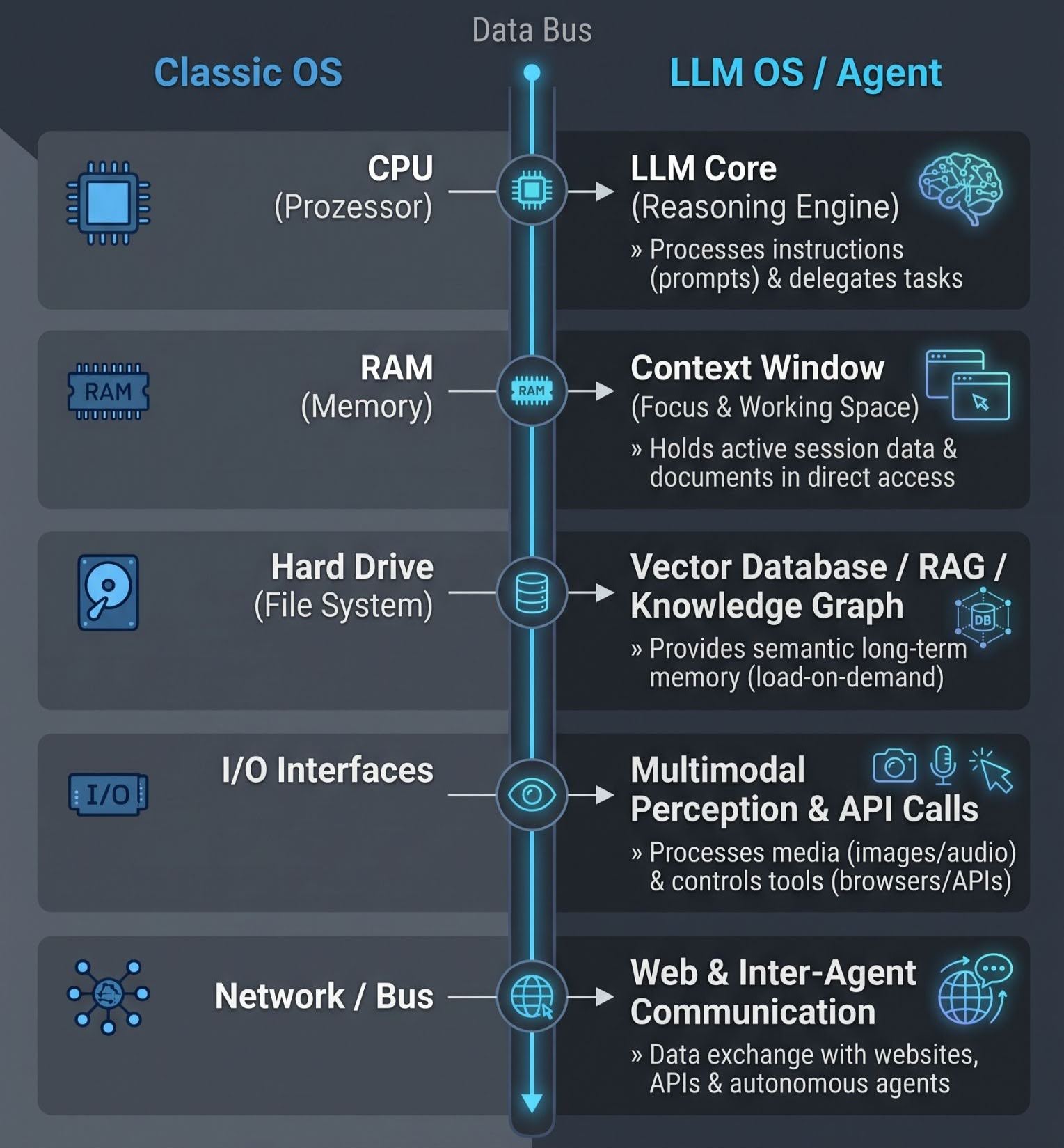
This operating system model fundamentally shifts application modernization challenges. The crucial question for developers and IT architects is no longer how to integrate AI into an existing application, but how to redesign existing applications so they run natively on this new LLM OS.
Application generation within this operating system occurs dynamically and on demand. Instead of relying on pre-installed standard applications, the system generates, tests, and isolates programs in real time based on natural language descriptions. The operating system interface scales its cognitive capacity dynamically according to available hardware resources, as illustrated by a multi-tier intelligence model.
| Intelligence Level | Required Model Class | Functionality & Routing Layer |
|---|---|---|
| Level 0 | No models (Regex layer) | Exclusively deterministic keyword matching and static app templates. |
| Level 1 | Tiny LLM (0.5B to 1B parameters) | Local, extremely fast model for prompt classification and template routing. |
| Level 2 | Local LLM (7B to 14B parameters) | Autonomous, local app generation without cloud dependencies via resource monitors. |
| Level 3 | Cloud Interfaces (e.g., GPT-5, Claude) | Full model escalation for highly complex, unstructured development tasks. |
To guarantee execution safety, generated programs pass through a multi-stage filter. A deterministic security scan blocks risky operations—such as dynamic code evaluation or unauthorized frame access—before users explicitly approve requested permissions. Execution takes place in isolated sandbox environments like WebAssembly (WASM) or Docker containers using cryptographically signed authorization tokens.
Technical Standardization of Autonomous Systems: CLAUDE.md vs. AGENTS.md
To systematically minimize common failure patterns in autonomous systems, structured behavioral guidelines have emerged in the form of Markdown configuration files. The community-adapted CLAUDE.md specification builds on Karpathy’s empirical observations regarding the most frequent error sources in coding AI systems. These guidelines focus on four fundamental codes of conduct to increase precision in software-based system interaction:
- Think before coding: Before modifying code, the agent must explicitly state assumptions, evaluate architectural trade-offs, and ask clarifying questions, preventing uncontrolled misassumptions.
- Simplicity first: Because models often lean toward complex, monolithic, and fragile builds, this rule commits the system to minimal, functional implementations.
- Surgical changes: Modifications must strictly occur at the requested locations, preventing unsolicited refactoring or cosmetic reformatting.
- Goal-driven execution: The desired end result is precisely defined; the agent autonomously chooses the optimal path and verifies outcomes through automated tests.
While CLAUDE.md primarily optimizes interaction between a human developer and an assistant coding tool, the open standard AGENTS.md (managed by the Linux Foundation) addresses the challenges of fully autonomous systems operating without direct human oversight.
| Core Rules for AGENTS.md | Technical Implementation & Declarative Syntax | Security Relevance & Error Prevention |
|---|---|---|
| Permission Boundaries | Explicit declaration of allowed and forbidden paths in the system prompt. | Prevents unauthorized access to environment variables and production databases. |
| Auditability | Comprehensive logging of all tool calls and system changes. | Enables full reconstruction and state rollback. |
| Failing Loudly | Immediate termination at unexpected system boundaries instead of improvisation. | Prevents uncontrolled hallucinations and cascading errors in operations. |
| Physical Memory File | Continuous reading and writing of a MEMORY.md structure. | Protects against context loss during inference resets and ensures cumulative learning. |
This standard is now natively interpreted by leading AI development platforms such as OpenAI Codex, Cursor, and GitHub Copilot. Developers are encouraged to maintain a central master file and link it to tool-specific configurations via symlinks.
The Knowledge Layer Problem and Memory Architecture
A major bottleneck in designing autonomous agent systems is the knowledge layer problem described by Karpathy. Traditional Retrieval-Augmented Generation (RAG) searches unstructured raw data from scratch for every user query. Consequently, the agent redundantly performs the same cognitive processing during each interaction without accumulating synthesized connections over time.
To overcome this inefficiency, the LLM Wiki Compiler concept converts unstructured data sources, PDFs, and notes into a dense network of structured Markdown pages in advance. The agent then navigates this pre-compiled, semantic encyclopedia rather than scanning unstructured text snippets.
However, this architecture presents challenges regarding data freshness and provenance. Once synthesized wiki pages build upon one another, outdated information risks being propagated unverified, diminishing the agent’s factual accuracy. Modern agent systems therefore implement freshness indicators and hybrid search algorithms to continuously verify knowledge base reliability.
Strategic Marketing Use Cases for the Karpathy Agents Agency
For marketing organizations and modern tech teams, merging agent frameworks with communication protocols like the Model Context Protocol (MCP) unlocks entirely new value chains. MCP serves as a universal translator, opening up relational data sources, CRM systems, and ad platforms to AI agents without requiring complex, proprietary API integrations.
| Marketing Use Case | Integrated MarTech Systems | Agentic Approach & MCP Interface | Business ROI & Impact |
|---|---|---|---|
| Cross-Channel Campaign Analysis | Google Ads, Facebook Ads, TikTok, HubSpot, CRM | Connecting MCP servers to automatically query and normalize metrics. | Reduces weekly analysis effort from 4 hours to 4 minutes. |
| Proactive GEO / SEO Content Gap Analysis | Search Console, Google Analytics, WordPress, Semrush | Continuous monitoring of keywords ranking in positions 4–10 experiencing traffic loss to optimize content. | Saves 6 hours of work per week; increases ranking relevance. |
| Real-Time Budget Reallocation | Google Analytics, Google Ads, Meta Ads | Campaign-level CPA threshold monitoring with automatic pausing upon deviations. | Prevents misallocated ad spend; enables minute-by-minute campaign optimization. |
| Conversational Product Discovery | Mixpanel, SQL databases, Elasticsearch | MCP-assisted answering of complex customer queries via real-time CRM data analysis. | 4.4x conversion rate increase compared to traditional search. |
A particularly promising approach stems from applying Karpathy’s autoresearch principle to digital marketing. In his original machine learning research project, Karpathy initiated a system that autonomously optimized a language model based on three core files:
- prepare.py for data preparation
- train.py as an agent playground
- program.md as the instruction set
By enforcing a strict inference time budget of exactly 5 minutes per run, all experiments remained directly comparable—allowing the system to run 126 experiments overnight and deliver an 11% efficiency gain.
In data-driven marketing and tech teams, this principle can be applied to campaign optimization. The agent is assigned a fixed inference time budget and authorized to autonomously adjust bids, keyword lists, and ad formats within a sandboxed pre-production ad account. Synthetic conversion probability serves as the core optimization metric.
Overnight, the agent executes hundreds of simulated micro-split tests, evaluates results against mathematical marginal cost curves, and immediately discards inefficient campaign layouts. The next morning, human campaign managers receive an optimized, validated ad setup that significantly outperforms human-built drafts—without spending manual labor hours on granular adjustments.
Strategic Recommendations
Building an autonomous Karpathy agent architecture marks the transition from a manually managed organization to a software- and agent-native enterprise structure. Companies that align early with this architecture secure significant efficiency and relevance advantages at tomorrow’s digital interfaces. We recommend the following strategic steps for implementation:
- Build machine-readable foundations: Before integrating complex agent systems, existing web infrastructures must be made understandable for generative synthesis systems through standardized schemas, (Web) MCP interfaces, and dedicated knowledge graphs (with a context and semantic layer system where appropriate).
- Establish strict security architectures: Deploying fully autonomous systems requires defining permission matrices according to the AGENTS.md standard without compromise. Critical system areas must be isolated using hardware-level sandboxes and tied to mandatory human-in-the-loop approval processes.
- Incrementally roll out focused, specialized agents: Instead of building monolithic, all-purpose AI systems, establishing modular agent networks with clearly defined tasks, individual workspace files, and inheritable skill allowlists offers a technically safer and more cost-effective path.