


Optimize Text for AI with the Cosine Similarity Tool “Semantic Overlap Checker”
Classic search engine optimization is rapidly losing ground, while generative AI models are fundamentally revolutionizing the digital search for information. Anyone who wants to be found in the precise answers of ChatGPT, Gemini, and Perplexity must understand and actively use the mathematical logic behind Generative AI Optimization (GAIO).
TL;DR: The Essentials at a Glance
- GAIO instead of classic SEO: Optimization is based on the semantic understanding of Large Language Models (LLMs) instead of rigid keyword densities.
- Mathematical comparison: The cosine similarity check measures the content and contextual proximity between your content and the ideal AI response.
- RAG Simulation: Modern GAIO tools simulate the selection process of AI search engines to drastically increase your chances of being cited as a source.
- Quality over Quantity: Precise, information-dense content wins over artificially bloated text deserts.
- Use our tool for free: Semantic Overlap Checker.
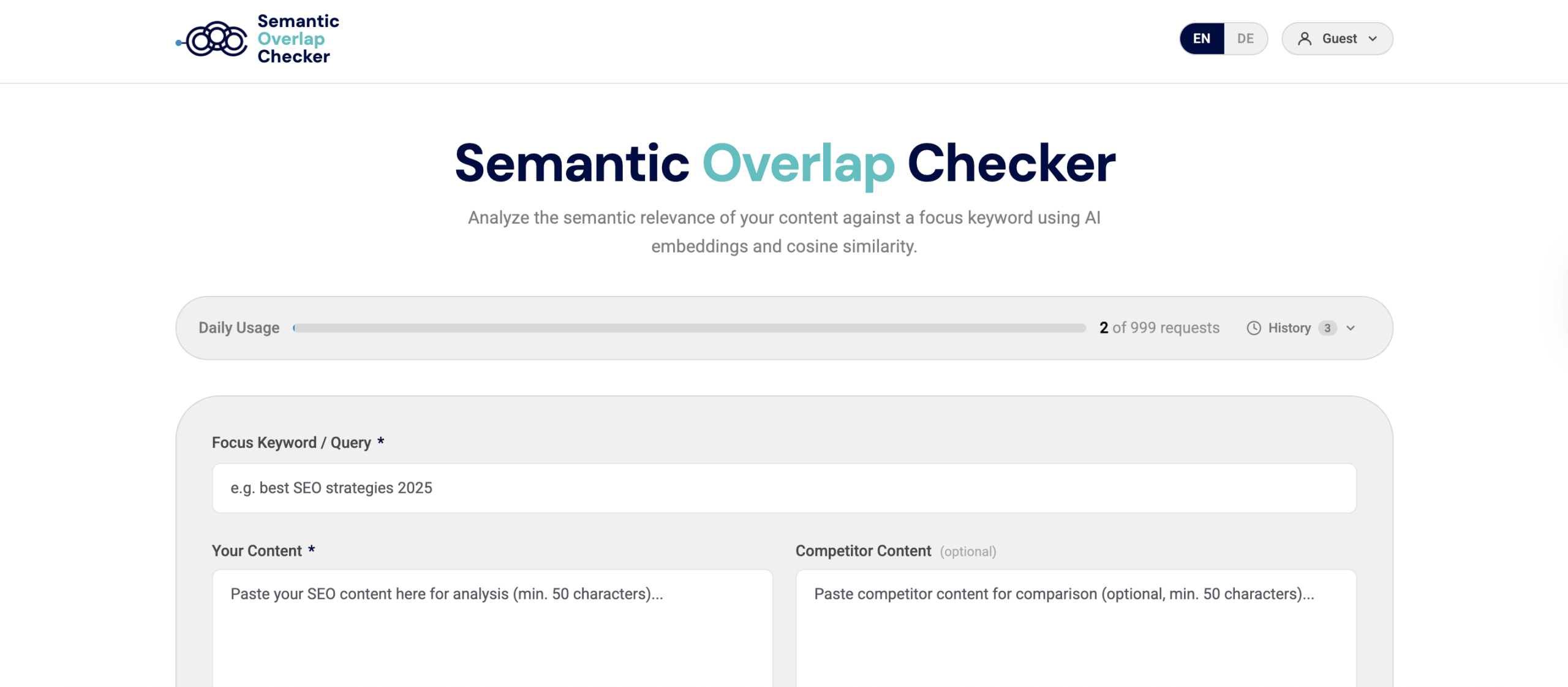
Measure, Match, Maximize: The Paradigm Shift in Content Marketing
The way people consume information has fundamentally shifted. In the past, users asked for isolated terms; today, they formulate complex, dialogue-oriented prompts. Traditional SEO strategies that primarily focus on placing exact keywords fall short here. GAIO tools address exactly this breaking point. They do not analyze texts based on word frequencies but decode the underlying meaning to align content exactly with the filtering mechanisms of modern language models.
Semantics Instead of Search Terms: The New Logic of Relevance
To understand how language models and GAIO tools work, a tangible model helps. Imagine that global knowledge were a gigantic, multidimensional mountain of knowledge. Every topic, every term, and every linguistic nuance has precise geographic coordinates in this space. A text about “efficient employee leadership” lies on the same mountain peak as a text about “modern management of teams,” even if completely different words are used.
The cosine similarity check acts as a digital compass: it measures the exact angle between the location of your text and the peak that the AI has defined as the perfect answer. The smaller this angle, the higher the mathematical similarity. Those who understand the algorithm gain visibility. Those who hit the context gain trust. Those who deliver value ultimately win the customer.
Read also: Building Authority with Semantic SEO: Guide to Success.
The Transformation of Text Into Numbers
Before a mathematical comparison can take place, language must become readable for the machine. GAIO tools use highly developed AI models that translate your text into so-called embeddings.
From Word to Vector
In this process, the text is broken down into tokens and converted into a long chain of numbers – a vector. This vector represents the semantic DNA of your content within the previously described mountain of knowledge.
The Mathematical Dimension of Language
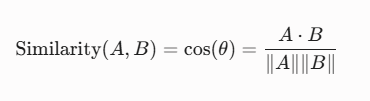
These vectors do not operate in a two-dimensional coordinate system but in spaces with thousands of dimensions. Each dimension represents a specific content feature or stylistic property. The subsequent cosine similarity check uses the mathematical formula to compare the orientation of two vectors in space independently of their absolute word count.
Find Facts, Formulate Focus: The Three-Stage Analysis Process
The use of a GAIO text analysis tool follows a clear, structured logic that mirrors the internal process of Retrieval-Augmented Generation (RAG).
- Vectorization of content: The tool analyzes your provided text and converts it into a high-dimensional vector via a standardized embedding model.
- Comparison with the reference: The vector of your text is mirrored with the vector of an optimal AI response or a specific user prompt.
- Calculation of the cosine angle: The tool calculates the mathematical similarity. A score of 1.0 means absolute semantic congruence, while values close to 0 signal complete irrelevance.
Direct Comparison: SEO vs. GAIO
The differences between classic optimization for search engines and algorithmic adjustment for language models are fundamental. The following matrix illustrates the strategic shifts:
Criterion | Traditional SEO | Generative AI Optimization (GAIO) |
Target Audience | Human users & Google Bot | Large Language Models (LLMs) & RAG systems |
Core Focus | Keyword density and backlink structure | Semantic relevance and contextual proximity |
Measurement Method | Search volume, rankings, click-through rate (CTR) | Cosine similarity, citation rate in LLMs |
Text Structure | W-questions, long information texts | Concise, directly usable fact blocks |
A common misunderstanding in practice is the assumption that longer texts automatically have higher relevance. With cosine similarity, however, it is different, as the mathematical process only evaluates the direction of the vectors in space, not their absolute length. A compact, precise paragraph that answers a specific question without detour can therefore have a significantly higher cosine similarity to the search query than a long-winded, ten-thousand-word blog post. For your content strategy, this means a clear shift toward maximum information density and the consistent avoidance of filler text.
Conclusion: The Future Belongs to Context-Strong Content
Analysis using cosine similarity proves that optimization for AI search engines is not alchemy but based on precise mathematics. Those who understand how GAIO tools build the semantic bridge between user prompts and web content can future-proof their content strategy. It is no longer about feeding algorithms with keyword repetitions, but about presenting the most precise, logically best-structured answer to the AI on a silver platter.
What experiences have you already gathered with optimizing your content for AI search engines or using semantic analysis tools?
Optimize Your Texts Now with the Semantic Overlap Checker
Do you want to know how well your inbound content is prepared for the filters of ChatGPT, Gemini, and Google AI Overviews? We have built a tool that handles the complex vector mathematics for you and delivers directly actionable insights.
Analyze your content now for free with the Semantic Overlap Checker and make your copy ready for the era of AI search.
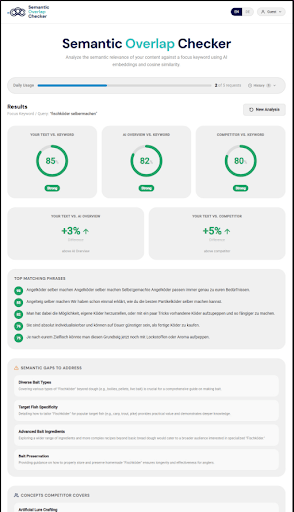
- Objective: The tool optimizes texts specifically to be recognized, preferred, and cited by Large Language Models (LLMs) like ChatGPT or in Google AI Overviews as a reliable source (“grounding source”).
- The mathematical approach (embedding): The tool uses models from the Google Gemini Stack to translate both your defined focus keyword and your written text into mathematical values (vectors) in a high-dimensional space.
- Optional competitor comparison: You can optionally input the URL of the top-ranking Google competitor. The tool also vectorizes this text to pinpoint the semantic gaps and theme concepts still missing in your draft.
- Cosine Similarity calculation: The system measures the mathematical distance (Cosine Similarity) between points in space. It doesn’t check pure keyword density but how close your text comes to the semantic meaning of the keyword or the ideal AI response.
- Simplified KPI output (traffic light system): The complex vector mathematics is translated for the user into an intuitive percentage value (0% to 100%) with color coding:
- Green ($\ge$ 75%): High semantic overlap. The text has the necessary depth and is optimal for AI indexing.
- Yellow (50% – 74%): Moderate overlap. The topic is met, but there are still critical content gaps.
- Red (< 50%): Poor overlap. The text lacks contextual substance; revision is urgently necessary.
For further information, contact us and check out our related webpage: Semantic Overlap Checker.
Definitions: The GAIO Glossary
- Generative AI Optimization (GAIO): The strategic optimization of digital content with the goal of being selected and cited by generative AI models as a primary source of answers.
- Cosine Similarity: A mathematical measure of the similarity of two vectors, calculating the cosine of the angle between them in a multi-dimensional space.
- Embeddings: The representation of words, sentences, or entire documents as numerical vectors, making the semantic meaning of the text mathematically tangible.
- Retrieval-Augmented Generation (RAG): A framework where an AI model accesses external knowledge bases while answering a question to generate reliable and current facts.
Frequently Asked Questions (FAQ)
How high should a good cosine similarity score be in GAIO tools?
An ideal score depends heavily on the embedding model used. Generally, in practice, a value of 0.80 (or 80%) or higher is considered a strong semantic match. Peak values above 0.90 signal to the tool that your content is extremely likely to be considered by an AI as a suitable answer source.
Can traditional SEO tools replace the cosine check?
No, because classic SEO tools are based on matching strings and keyword frequencies. They are blind to the deep semantic meaning and context that an LLM analyzes via vectors. GAIO tools bridge this technological gap.
Why does cosine similarity react so sensitively to linguistic context?
Because the underlying language model has learned how words interact in human language. A word like “bank” receives a completely different vector position in the context of “money” than in the context of “park.” The cosine check captures these nuances precisely.