


Why E-E-A-T Still Matters
For the last several years, the SEO community has obsessed over keywords, backlinks, and algorithms. But if there’s one principle that has stood the test of algorithm updates, core ranking shifts, and the rise of AI search, it is this:
Good content alone is not enough. Content must be credible.
Google’s concept of E-E-A-T, Experience, Expertise, Authoritativeness, and Trustworthiness, is not a literal ranking factor you can “add” with a tag or a toggle. Instead, it’s a set of quality signals that search systems and human raters use to evaluate whether your pages are genuinely helpful, accurate, and aligned with user intent. These principles are outlined in Google’s Search Quality Rater Guidelines – a publicly available guideline. Reviewing the document can give deeper insight into how experience, expertise, authoritativeness, and trustworthiness are defined.
Ben Gomes, who leads the Learning & Sustainability organization at Google, said in a CNBC interview:
“You can view the raters’ guidelines as where we want the search algorithm to go. They don’t tell you how the algorithm is ranking results, but they fundamentally show what the algorithm should do.”
Misunderstanding E-E-A-T is easy. You can sprinkle author bios and trust badges on your pages, but if your site can’t demonstrate real expertise, real experience, and real reputation, you’ll still struggle to rank for valuable competitive keywords, especially in YMYL (Your Money or Your Life) topics.
This article doesn’t just define “what is E-E-A-T”. It gives you an operational framework to for content, workflows, and site architecture, with an actionable E-E-A-T checklist and roadmaps for immediate impact.
The E-E-A-T Concept: What Does Each Component Stand for?
Before we go further, it helps to operationalize each letter in the Google E-E-A-T acronym:
| Experience | Expertise | Authoritativeness | Trustworthiness |
| – Is the author named? | – Does the author have proven subject matter competence? | – Do others recognize this site/author as a reliable source in the field? | – Is the content transparent, accurate, and safe for users? |
| – Have they tested the shown process? | – What are their Credentials? | ||
| – Are they demonstrating firsthand knowledge? | – What is their track record? |
Together, these form a multi-layered credibility signal that humans and algorithms both recognize as indicative of high-quality content, especially when user stakes are high (e.g., health advice, legal guidance, financial decisions).
Understanding each component is one thing; implementing them consistently across your site is another. That’s what this framework is designed to do.
Part I. Audit: Where Are Your E-E-A-T Gaps?
Before you improve anything, you need to know where the problems really are.
1. Content Audit: Is Your Content Credible?
A meaningful E-E-A-T content audit goes beyond surface-level checks and asks if your content genuinely demonstrates competence and real-world experience.
Credible content reflects firsthand knowledge through case studies, original data, or concrete examples. It clearly attributes expertise to named contributors with verifiable credentials, and supports claims with authoritative sources such as research, official documentation, or recognized industry references. It should also be maintained to reflect current facts and standards.
A common mistake is treating E-E-A-T as a set of checkboxes, adding an author bio or a citation without ensuring that these elements actually substantiate credibility. Content can appear informative and still fail E-E-A-T expectations if it sounds correct but does not demonstrate depth, experience, or subject-matter competence.
2. Author Audit: Are People Credible?
Author signals are not decorative SEO elements. They are how both users and search systems associate content with a real, accountable source.
Each author should have a substantive profile that clearly communicates relevant credentials and experience, with signals that can be independently verified through professional profiles, publications, or industry recognition outside your website.
Expertise should be consistent across related topics, reinforcing topical ownership rather than scattered, one-off contributions. For content with higher stakes, visible expert review or editorial oversight further strengthens trust.
When an author’s expertise is superficial or purely self-declared without external validation, it weakens perceived credibility. And this is an issue that human quality raters can detect even when algorithmic ranking factors are not transparent.
3. Site Reputation Audit: What Does the Internet Say About You?
E-E-A-T does not exist in a vacuum. Your credibility is shaped not only by what you publish on your site, but also by how others reference and validate your brand across the web.
Signals such as mentions and backlinks from reputable sources, testimonials from recognized customers, industry awards, third-party citations, and broader social or professional recognition all contribute to perceived authoritativeness and trust.
When a site operates in isolation with no external validation or authority signals, its credibility is inherently weaker, no matter how refined or well-produced the on-page content may appear.
Turning Principles into Practice
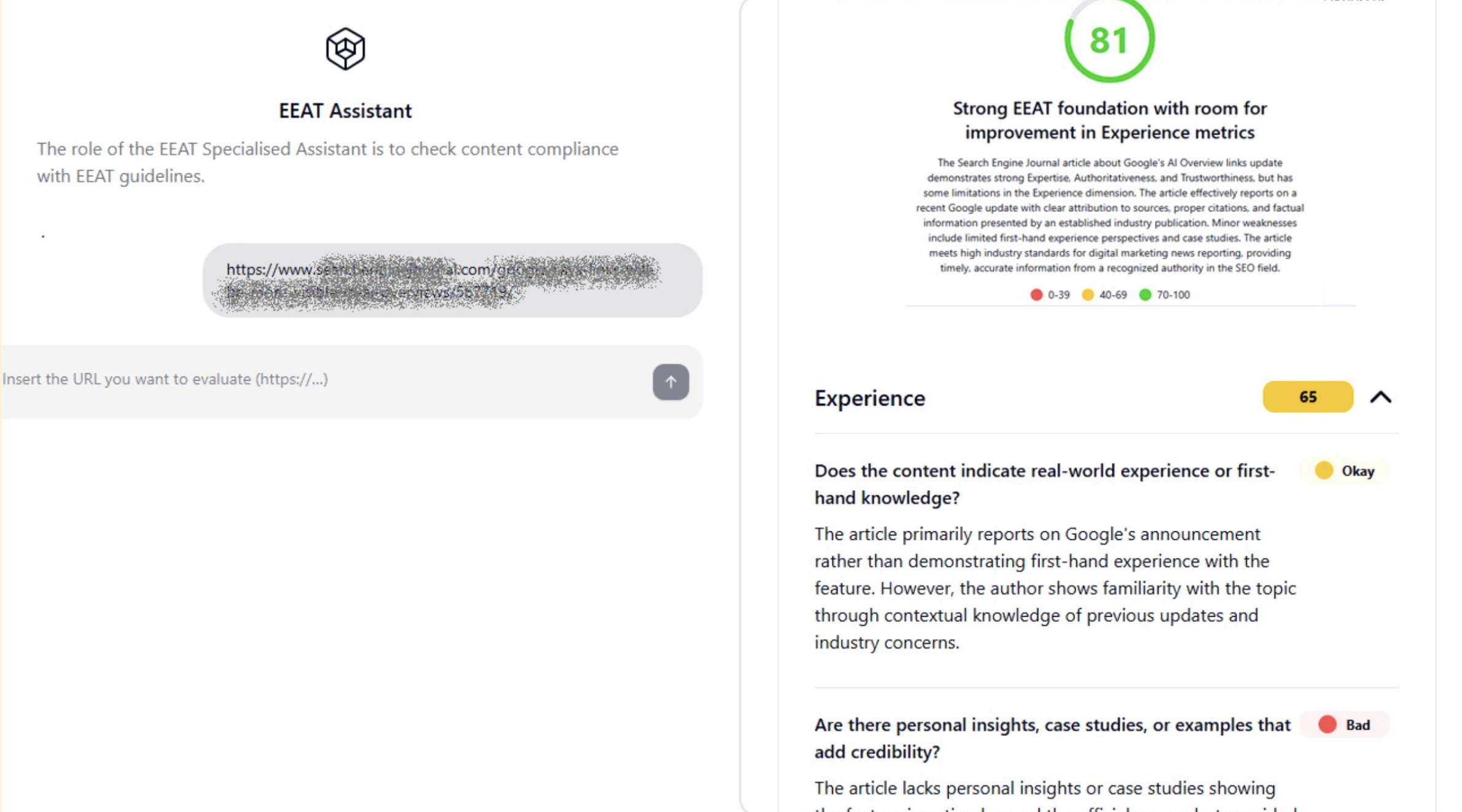
To partially automate the described framework, we developed a tool – EEAT Assistant, designed to analyze web pages against key E-E-A-T criteria.
The tool functions as a specialized chatbot. Users simply paste the URL they want to evaluate into the chat, and the assistant generates a structured analysis of the page across Experience, Expertise, Authoritativeness, and Trust signals. The output includes identified gaps as well as concrete, actionable recommendations for improvement.
Unlike generic content graders, EEAT Assistant focuses specifically on credibility indicators such as author transparency, external validation signals, trust elements, content depth, and structural clarity. This makes it particularly useful for content audits, pre-publication reviews, and ongoing quality governance.
We plan to make the tool publicly available so that teams can systematically evaluate and optimize content through an E-E-A-T lens rather than relying on intuition alone.
Part II. Optimize: Embedding E-E-A-T Deeply
Now that you know your gaps, here’s how to fix them for both search engines and users.
1. Experience. Show, Don’t Tell
Experience is often overlooked because it’s harder to fake than a keyword or a link.
Strategies for Experience:
- Include case studies with real outcomes and dates.
- Use screenshots, data extracts, or process maps.
- Include “what we did, what happened, and what we learned” sections.
- Share personal insights, not generic wisdom.
When you reveal your process and results, users perceive content as authoritative, and search systems treat it as more trustworthy.
2. Expertise. Build a Structured Author Reputation
Merely naming an author doesn’t convey expertise. You need to:
- Publish detailed author bios with credentials and links to verifiable profiles.
- Tie the authors consistently to the topic clusters they specialize in.
- Use “reviewed by” bylines for high-risk topics (health, finance, legal).
- Cite authors’ real publications or contributions elsewhere.
This creates a network of authority signals, just as expert credentials matter in traditional academic publishing.
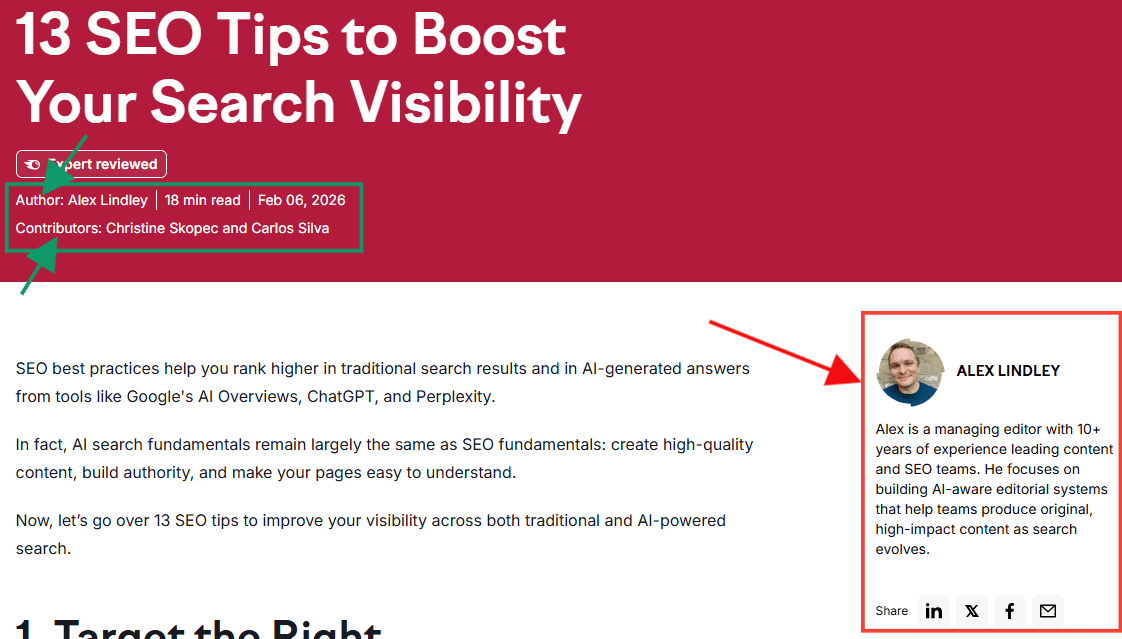
Here are some examples of adding authors to publication pages:
- The author’s name + author’s photo + job title + links to the author’s social media profiles
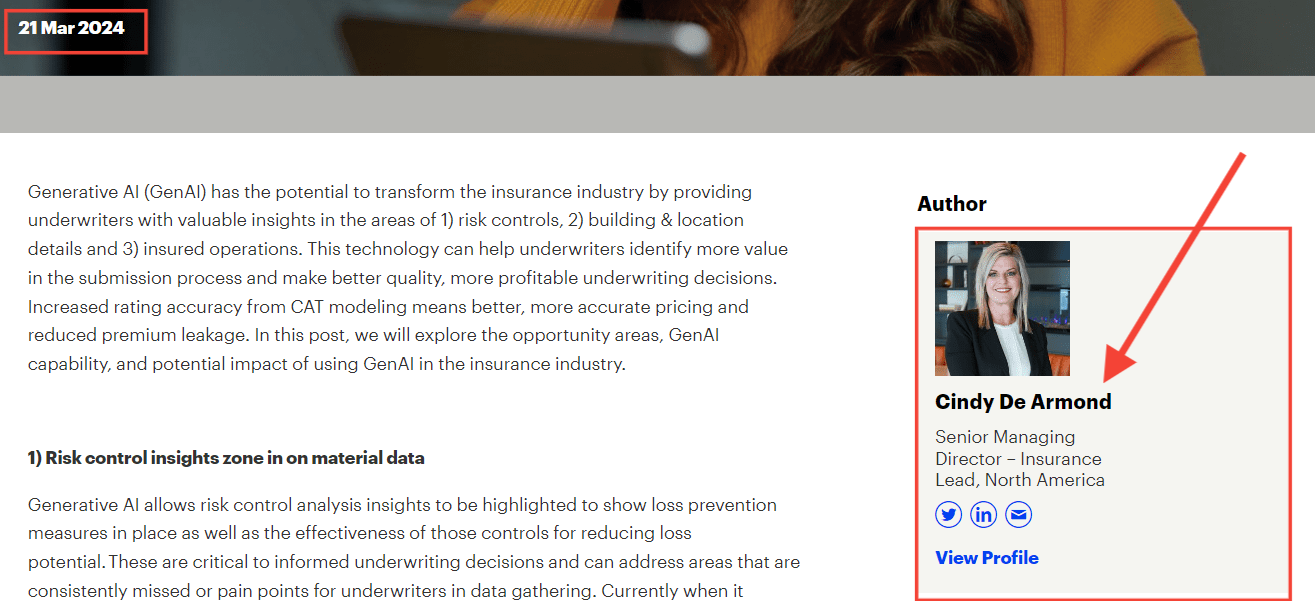
- The author’s name + author’s photo + job description + links to the author’s social media profiles. Additionally, in this example, contributors are added with links to their profile pages.
3. Authoritativeness. Build Recognition Beyond Your Site
Authority is not built through self-promotion, it is earned through external validation.
Brands strengthen their authoritativeness by being cited and mentioned by reputable industry publications, collaborating with recognized experts for quotes and insights, and publishing original research or proprietary data that others reference and link to.
Participating in knowledge-sharing webinars, expert panels, or curated roundups further reinforces credibility by positioning your brand within a trusted professional network rather than as a self-contained voice.
Authoritativeness scales best when others refer to you. That’s why digital PR, outreach, and reputational campaigns matter.
Backlink Report from SEO research (2025) finds that qualitative backlinks are viewed by SEO professionals as having the biggest impact on both rankings and site authority – a modern evolution of how backlinks contribute to E-E-A-T.
But others will only link to your site if your content is valuable and attention-worthy.
NOTE! Authoritativeness starts with topical focus. Choose the core topics you want to be known for and build systematic content depth around them. The more original, experience-driven, and useful content you publish within a defined subject area, the stronger your topical authority becomes, which expands ranking potential across related queries and increases the likelihood of earning authoritative mentions and links.
4. Trustworthiness. Eliminate Doubt
Trust is inherently fragile and, once damaged, difficult to rebuild. To sustain credibility, content should be transparently sourced and supported with reliable citations, while legal pages such as Privacy Policy, Terms, and disclosures are clearly accessible and easy to understand.
The About Us page should document verifiable credentials, recognitions, third-party reviews, and partnerships.
The Contact page must provide real, verifiable business details such as the legal entity, physical address, and reliable support channels.
Editorial standards and review processes should be documented and visible.
Sensitive topics should include appropriate disclaimers to set clear expectations.
These trust signals are especially critical in YMYL niches, where inaccurate or misleading information can harm users and rapidly undermine both credibility and search performance.
Part III. Technical & Structured Signals
While E-E-A-T is conceptual, there are concrete technical steps that reinforce it:
1. Schema Markup
Structured data should be used to make your content legible to search systems, and to connect people and organizations clearly to real-world entities.
Implementing the Person schema for authors, enriched with sameAs links, helps search engines verify identities and connects your contributors to their broader professional presence across the web.
Using the Article schema with author and reviewedBy properties clarifies who created the content and whether it has been reviewed by a qualified expert. This strengthens accountability and perceived expertise.
Adding the Organization schema establishes a consistent publisher identity, reinforcing brand credibility and trust signals across your site.
Marking up your About and Contact pages further supports transparency by signaling where users and search systems can verify who you are and how to reach you.
We explored the importance of Structured Data and case studies from well-known companies and the use of Schema Markup in the article “How to increase visibility with Structured Data (Schema Markup)”.
Altogether, schema markup reduces ambiguity and helps search systems reliably associate your content with real people, real organizations, and real responsibility – core foundations of E-E-A-T.
2. Internal Linking
Internal linking plays a structural role in building topical authority.
Links from broader cluster pages to in-depth expert articles help search systems understand which pages represent deeper expertise.
Connecting author pages to their topic hubs reinforces subject ownership and clarifies who is responsible for specific areas of content.
When pages are organized into clear semantic clusters, crawlers can more easily infer topical depth and content relationships.
This structured linking model strengthens expertise signals by showing both thematic coverage and internal consistency across the site.
Part IV. Processes That Prevent E-E-A-T Decay
E-E-A-T is not a one-time optimization. It functions more like governance. Without ongoing processes, trust signals decay as content becomes outdated, authors change, or standards drift.
1. Editorial Review Workflows
High-stakes content requires formal review processes to maintain credibility over time.
Expert review stages ensure that claims are accurate and aligned with current standards. Recording who reviewed the content, when the review happened, and what changed creates accountability and traceability.
Archiving previous versions and showing “updated on” timestamps signals transparency and mirrors academic peer review practices.
This reinforces trust by showing that content is actively maintained, not published and forgotten.
2. Versioning & Content Freshness
Outdated facts can undermine trust faster than no facts:
- Set routine refresh cadences.
- Record update dates visibly.
- Prioritize refresh for high-traffic, high-risk pages.
Fresh, accurate content performs better both in users’ eyes and in search systems’ evaluations.
Part V. Measurement: How Do You Know It Worked?
You can’t optimize what you don’t measure. Traditional SEO KPIs tell only part of the story. For E-E-A-T, you also need to monitor:
- Branded search growth, which signals rising recognition and credibility.
- Organic visibility for expertise-related queries indicates topical authority formation.
- External citations and mentions reflect off-site validation.
- Engagement metrics such as dwell time suggest user trust and perceived value.
- SERP feature inclusion (e.g., featured snippets, trust panels)
An uptick in these signals often precedes ranking gains because search systems are learning that users trust your content more.
E-E-A-T Implementation Roadmap (30-60-90 Days)
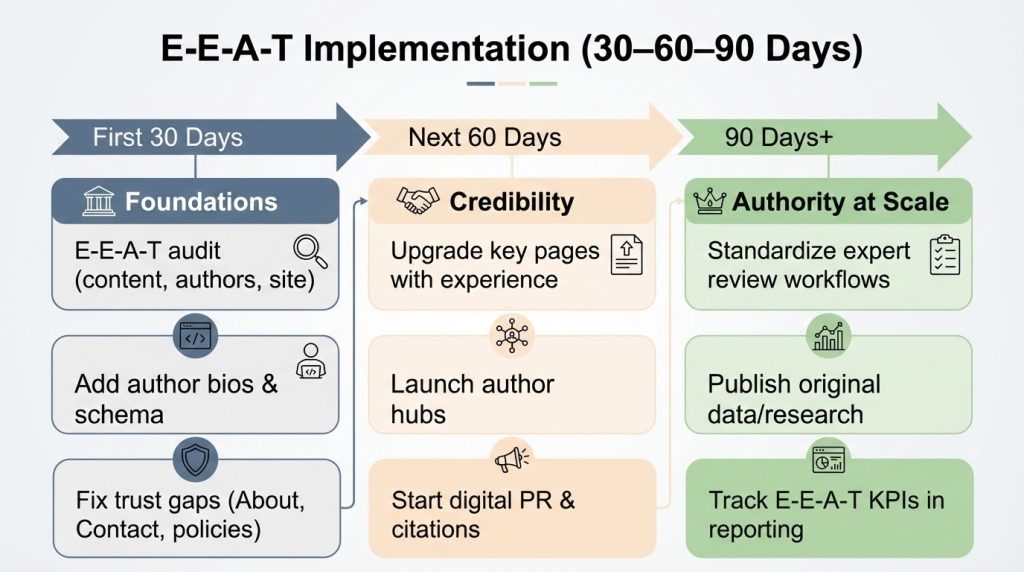
This image was generated by AI.
First 30 Days
- Audit content, authors, and technical trust signals.
- Implement basic schema and author bios.
- Patch obvious credibility issues.
Next 60 Days
- Rewrite priority content with real experience.
- Build structured author hubs.
- Organize digital PR or external citation campaigns.
90 Days and Beyond
- Scale trust workflows.
- Publish original research.
- Institutionalize E-E-A-T metrics in your SEO scorecards.
How to Use AI Safely Without Undermining Trust
AI can accelerate content production, but unmanaged AI use is one of the fastest ways to erode E-E-A-T. Search systems prioritize credibility, provenance, and first-hand experience signals that generic AI outputs rarely provide on their own. The goal is not to avoid AI, but to operationalize it within an E-E-A-T-safe workflow.
The risk is not just factual inaccuracy. Content that follows predictable structural patterns, vague generalizations, or formulaic phrasing can signal low originality and weak experience. Even Wikipedia documents common “signs of AI writing”, including overly generic language and uniform tone.
AI scales production, E-E-A-T scales credibility. The winning model is not “AI-first content,” but expert-led content with AI acceleration.
Final Thoughts
E-E-A-T is not a magic formula you add to a page like keywords. It’s a system of credibility signals that must be demonstrated, reinforced, and maintained.
When done right, E-E-A-T doesn’t just help rankings, it aligns your content with real user needs, builds reputation, and creates sustainable search performance.
The real challenge is operationalizing E-E-A-T at scale, especially for enterprise and mid-sized organizations with complex architectures, multiple stakeholders, and thousands of URLs.
At Digital Loop, we approach E-E-A-T as a measurable system rather than a theoretical concept. We combine custom MarTech solutions with deep technical expertise to strengthen structured data implementation, entity clarity, content governance, technical SEO, and performance monitoring. With extensive experience working with enterprise and medium-sized businesses, we help transform credibility into a scalable and trackable growth driver across search and AI ecosystems.
If your organization is ready to move from simply adding signals toward building a structured credibility framework that supports search visibility, AI discovery, and real user trust, we can help you turn strategy into execution. Lets talk!