


The way people search for information is fundamentally shifting. We no longer just type disconnected keywords into search bars. Instead, we hold multi-turn conversations and nuanced dialogues with artificial intelligence. Since the public debut of ChatGPT in late 2022, generative systems have seen an adoption wave unmatched in the history of modern computing.
According to the landmark NBER Working Paper w34255 (How People Use ChatGPT) by Aaron Chatterji, Thomas Cunningham, David J. Deming, and their team, over 700 million people were using ChatGPT on a weekly basis by mid-2025. That represents roughly 10% of the world’s adult population, dispatching an estimated 18 billion messages into the system every single week.
For marketers, the conclusion is clear: traditional Search Engine Optimization (SEO) alone no longer covers the customer journey. If we want our brands to be part of the synthesized answers generated by conversational AI bots, we have to unpack what real users are asking and reverse-engineer how they structure their prompts.
Here is how we deconstruct the apparent black box of user prompts and turn those behavioral patterns into actionable visibility.
From Tech Novelty to Mass Market: Who Is Actually Using ChatGPT?
Demographic data dismantles the stereotype that AI chatbots are niche tools reserved for software engineers or early tech adopters. While roughly 80% of weekly active users were male during the initial months following launch, that balance leveled out completely by mid-2025.
Global adoption reveals a critical operational dynamic:
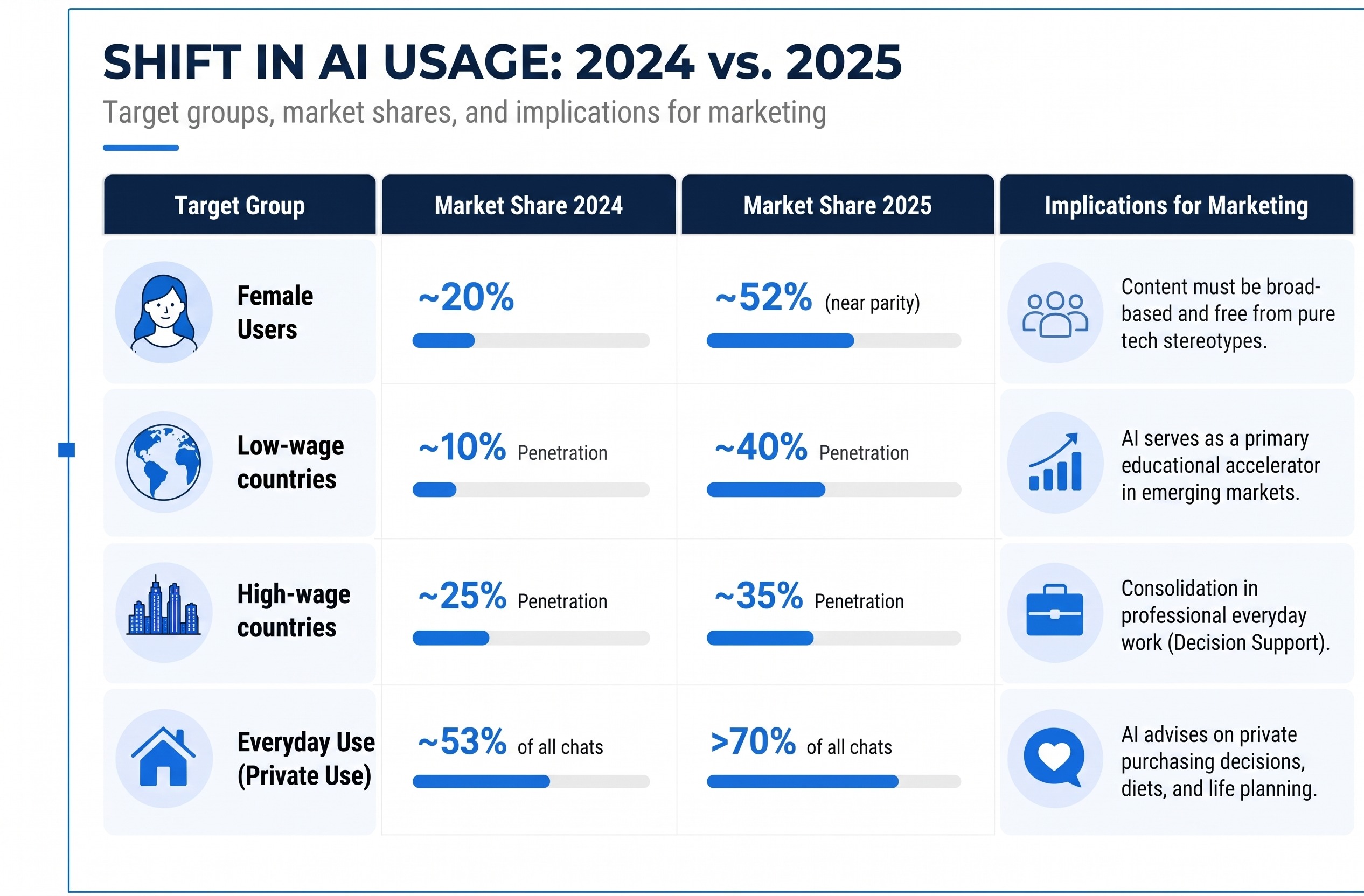
The vast majority of engagement has shifted toward personal, non-work tasks, representing over 70% of conversations. This everyday utility generates immense economic value beyond corporate productivity metrics. Economists estimate the annual consumer surplus driven by generative AI in the US alone at roughly $97 billion.
Consumers are increasingly vetting products and shaping purchasing decisions directly inside AI dialogues. Brands that fail to establish a presence within these conversational interfaces risk losing their direct link to buyers entirely.
Asking vs. Doing: Why Users Treat AI as an Advisor, Not Just a Scribe
To anticipate how buyers interact with conversational systems, we need to examine user intent. The NBER research establishes a clear three-part taxonomy:
- Asking (Information Seeking & Decision Support): The user seeks guidance, objective explanations, or help making an informed decision.
- Doing (Task Delegation & Execution): The user delegates specific work, such as writing code or generating raw text.
- Expressing (Playful & Reflective Interaction): Unstructured dialogue, roleplay, or personal brainstorming.
Over time, user behavior has shifted decisively:
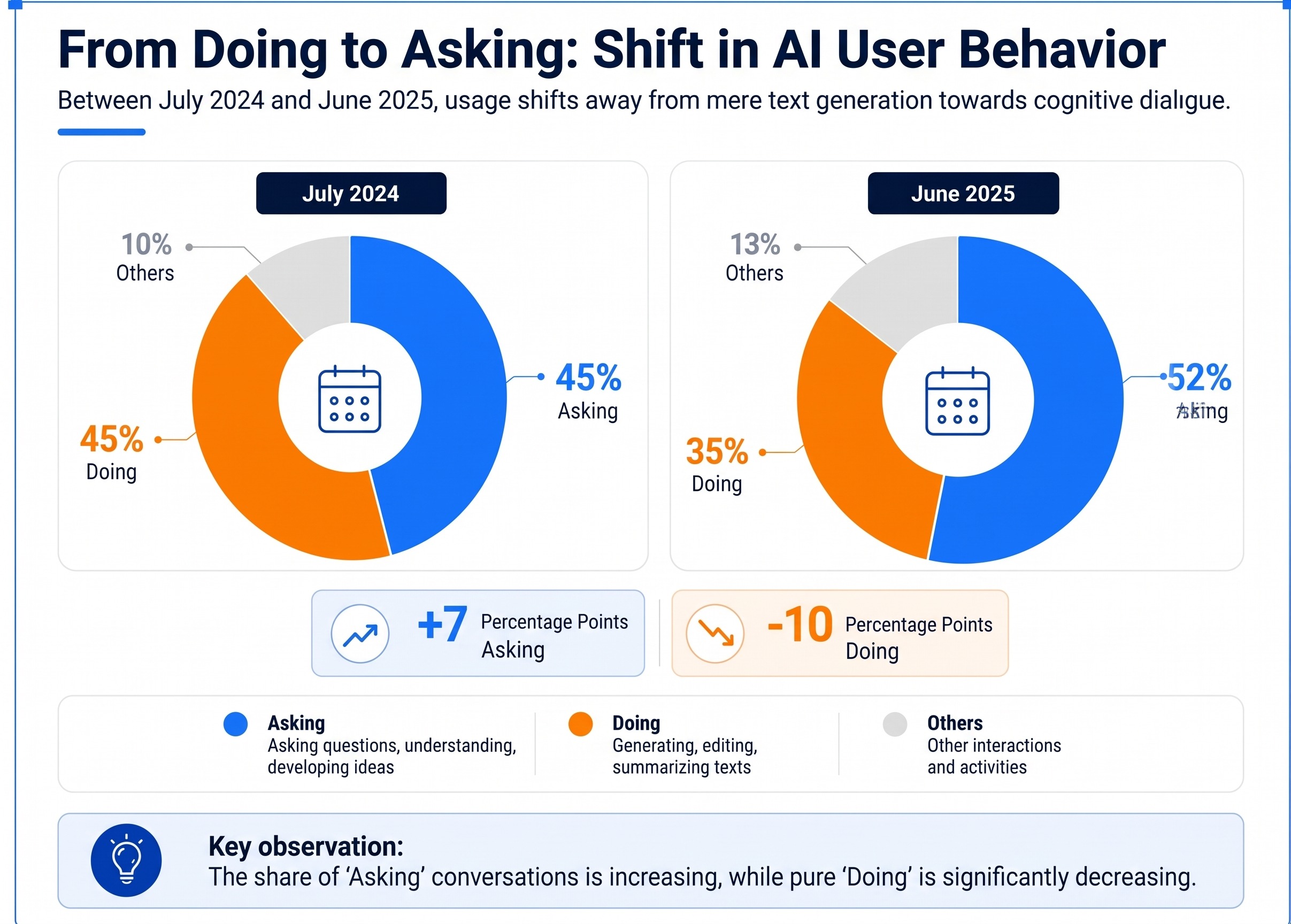
Asking expanded to account for 52% of all activity, while pure Doing declined from 45% to 35%.
As the authors observe:
Three core domains represent nearly 80% of all global sessions: Practical Guidance (~29%), Seeking Information (~24%), and Writing (~24%). In enterprise workplace environments, writing tasks still constitute 40% of all messages.
Yet there is a key operational nuance: two-thirds of professional writing tasks do not involve generating copy from scratch. Instead, users ask the model to refine, audit, summarize, or translate text they have already written.
The Evolution to GEO: Staying Visible in the AI Evoked Set
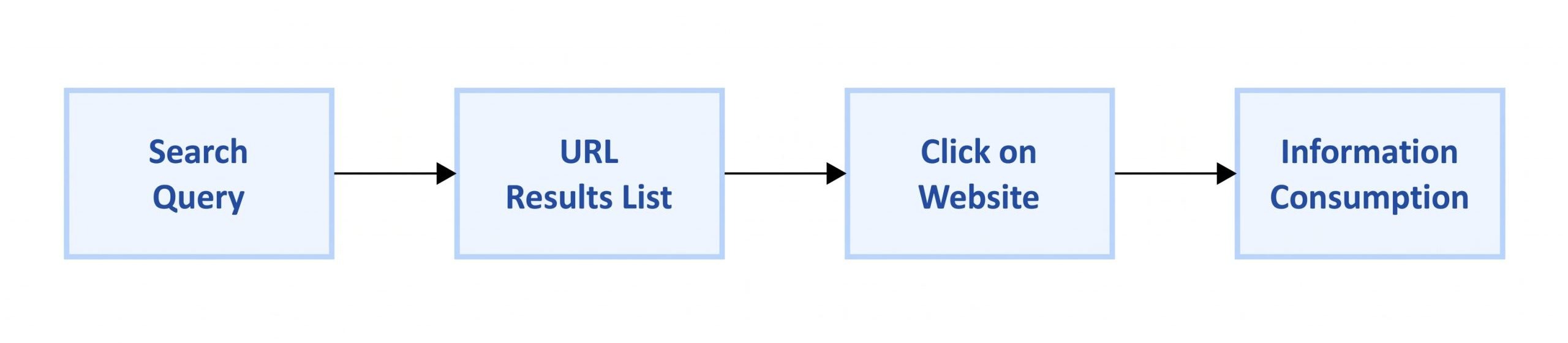
In classic search engines, the click was the core currency. The engine functioned as an index pointing to third-party web pages. With generative engines like ChatGPT, Gemini, and Perplexity, that intermediate click is often bypassed. The model retrieves web documents, evaluates claims, synthesizes context, and delivers a self-contained answer.
This structural shift forms the basis of Generative Engine Optimization (GEO), also referred to as GAIO or AEO. Competition has shifted away from raw keyword rankings toward brand mentions and citations embedded directly in conversational outputs.
Classic SEO-Funnel:
Moderner GEO-Funnel (AI-Mediated Consideration):
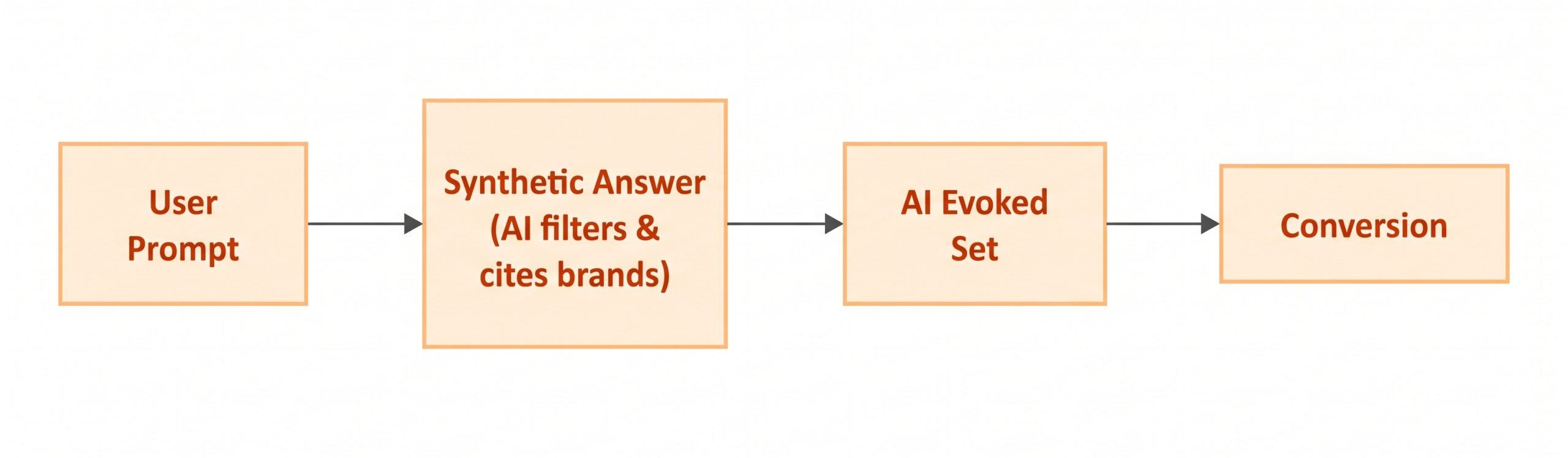
If a brand is absent from the AI Evoked Set, the pre-selection of vendors or solutions shortlisted by the engine, it functionally does not exist for that user at that moment. For content strategists, every asset must satisfy a high Grounding Necessity (GN) so that retrieval systems consider the domain indispensable.
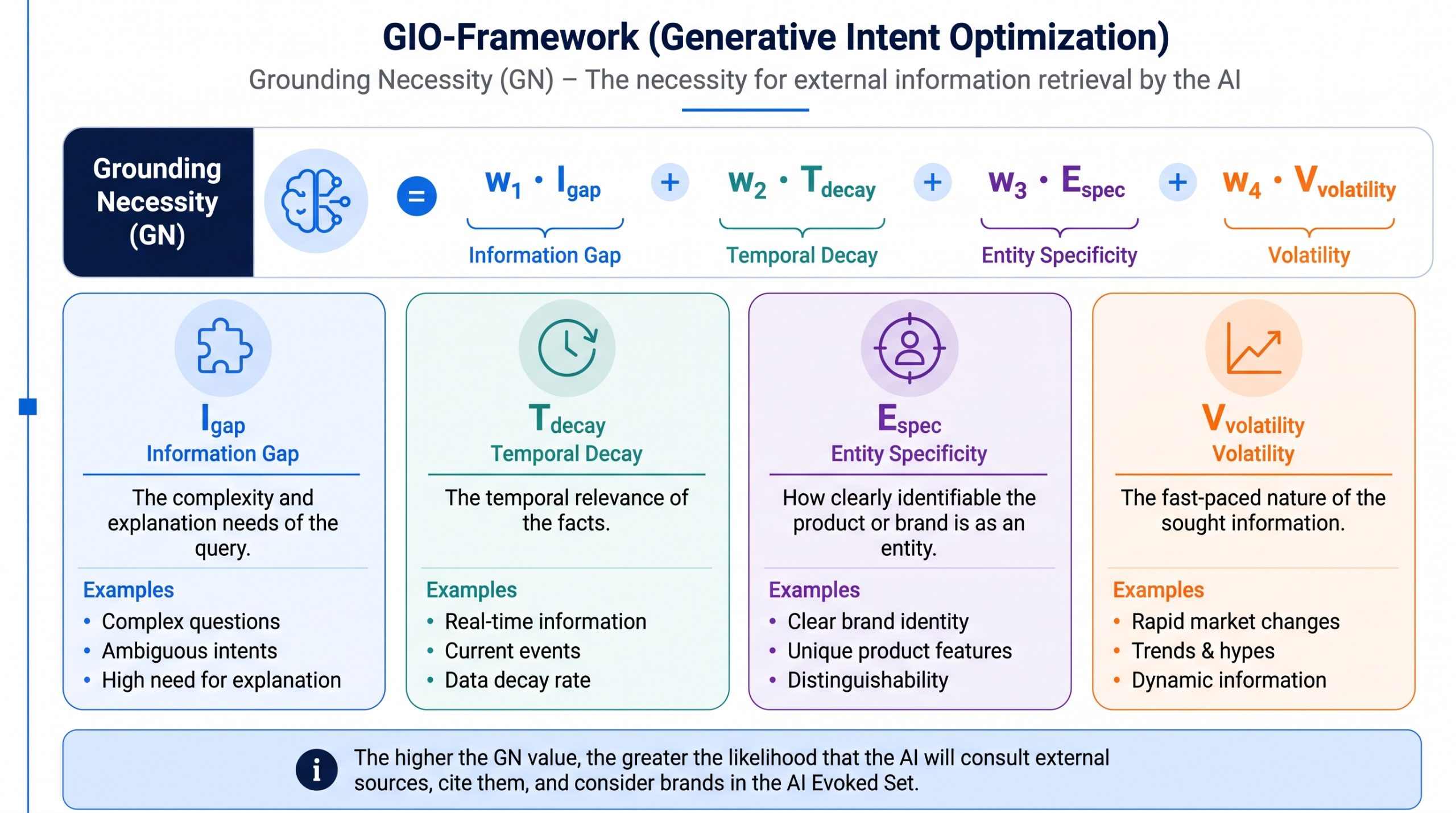
Only structured, fact-dense, and machine-readable data will convince Large Language Model (LLM) crawlers to select your domain as a primary citation source.
The Prompt Detectives: 3 Practical Methods to Decrypt User Queries
How do we identify the specific prompts prospective buyers feed into AI engines? We analyzed and tested the three primary approaches currently available:
Methode 1: First-Party Conversational Mining (Der Kunden-Spiegel)
- The Concept: Analyze unstructured conversational data your company already owns, including customer support tickets, live chats, CRM logs, and sales transcripts recorded via platforms like Gong.
- Implementation: By deploying connectivity frameworks like the Model Context Protocol (MCP), tools such as AirOps Prompt Discovery can interface directly with your repositories to extract organic language patterns and common phrasing.
- Practical Rating: 9/10. Real customers asking unscripted questions provide the clearest mirror of real-world AI queries. When an enterprise buyer asks your team, “How do I re-sync sensor telemetry after 500 operating hours?”, that question shares the exact syntactic structure of an AI prompt.
- Marketer Takeaway: Build detailed knowledge bases and technical documentation that match these natural queries syntactically. This directly feeds retrieval pipelines with authoritative answers.
Method 2: Third-Party Simulation and Algorithmic Tracking
- The Concept: Specialized monitoring platforms (such as BrandRadar, Dageno AI, or Profound) simulate prospective customer interactions by executing thousands of commercial prompts—such as “Best enterprise CRM for mid-sized manufacturers” or “[Brand A] vs. [Brand B]”—and logging which competitors get cited.
- Implementation: These systems calculate visibility probabilities using Bayesian inference to assess brand presence across variations:
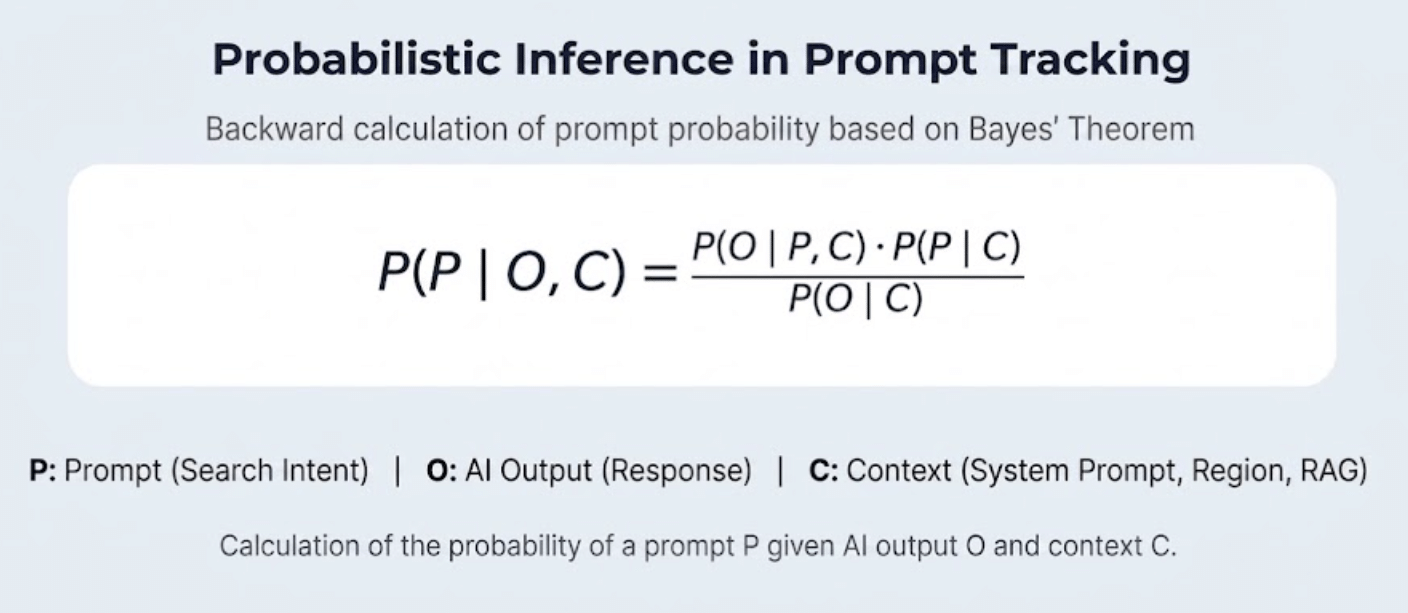
- This approach calculates the likelihood of an underlying prompt P given the observed AI output O and the operating context C.
- Practical Rating: 8/10. Crucial for competitive intelligence, tracking share of voice within AI answers, and auditing your position in the AI Evoked Set.
- Marketer Takeaway: Pinpoint the exact comparison queries and high-intent categories where competitors are cited over your brand, highlighting gaps in your content library.
Method 3: Data-Donation Research
- The Concept: Academic and commercial research groups leverage anonymized, voluntary data-donation pools where users share real ChatGPT export logs. The InVivoGPT dataset, for example, evaluates more than 825.000 interactions across 300 active users.
- Implementation: Data teams apply unsupervised clustering algorithms like BERTopic over message histories to identify psychological interaction types and query archetypes.
- Practical Rating: 6/10. Invaluable for foundational persona modeling and academic validation, revealing unfiltered searches around sensitive topics. However, the data collection overhead makes it unwieldy for everyday marketing operations.
- Marketer Takeaway: Use published findings from empirical studies to understand how users emotionally frame their queries. As the InVivoGPT team notes, conversational systems are transitioning from purely functional utilities into trusted problem-solving partners.
Practitioner Perspective: Bridging Qualitative Prompts with Search Volume
In our client work at Digital Loop, we regularly build frameworks to evaluate how users query platforms like ChatGPT, Gemini, and Google AI Overviews. Across multiple datasets, one lesson stands out: there is no secret shortcut to extracting an exhaustive database of user prompts directly from proprietary engines.
Reverse-engineering the logic behind model responses is our strongest avenue, but marketing teams face an immediate operational challenge: scale. Reconstructing a clever, hyper-specific prompt provides little strategic value unless you can determine how many people actually frame their problem that way.
To solve this, we rely on a hybrid validation model. We take conversational prompt patterns identified through first-party data and third-party AI tracking, and map them back to search demand data from Google search queries and Google’s “People Also Ask” repositories. Because conversational engines frequently reflect live web search demand through Retrieval-Augmented Generation (RAG), traditional search volumes serve as a reliable quantitative proxy for dialogue topics.
While not an exact mathematical match, this method yields a practical demand index. In operational marketing, directional clarity is what drives budget: we need to verify whether demand for an entity or pain point is low, moderate, or high. Combining the linguistic depth of AI prompts with the statistical grounding of search volume turns GEO into a measurable marketing discipline.
John Muñoz, Founder & CEO Digital Loop
Operational Guardrails: Understanding the Limits of Prompt Analytics
Teams deploying prompt analytics must account for several structural constraints:
- Strict PII Filtering: Both internal model safety guardrails (such as Anthropic’s Clio framework) and data-privacy regulations require aggressive anonymization of Personally Identifiable Information (PII). Highly granular, brand-specific details can get scrubbed before data reaches public analysis.
- Probabilistic Output Variance: Large Language Models are non-deterministic. Identical prompts can generate varied answers across sessions. Furthermore, integrated routing classifiers (like OpenAI’s dynamic search classifiers) decide on the fly whether a prompt triggers live web retrieval at all.
- The Algorithmic Self-Portrait (Hyper-Personalization): Modern conversational assistants utilize persistent memory. Research from TU Delft highlights that 96% of cross-session memories are generated unilaterally and silently by the AI during regular interactions. The model constructs an implicit background profile of the user, heavily personalizing its answers. Consequently, static “rankings” for a given prompt are largely obsolete.
- The Hawthorne Effect: In public datasets like WildChat, users are conscious of being recorded, prompting them to alter their behavior and self-censor sensitive or proprietary queries.
ChatGPT vs. Claude: Why One Uniform AI Strategy Fails
Treating all AI platforms as an identical monolith is an expensive mistake. Empirical usage analysis uncovers substantial behavioral differences across model ecosystems:
- Coding & Technical Query Share: Programming queries account for roughly 4,2% of messages in ChatGPT, compared to more than 30% inside Claude.
- Prompt Complexity: Claude users demonstrate highly analytical usage patterns, utilizing multi-step chained instructions, precise prompt scaffolding, and programmatic data manipulation.
- Regional Query Variances: While standardized taxonomies offer a high-level view, unsupervised clustering (such as BERTopic) shows that regional priorities differ sharply. Datasets from Brazil and India show heavy engagement with preventative healthcare and entrepreneurship strategies; in Pakistan, linguistic translation and theological analysis represent dominant clusters.
While ChatGPT dominates consumer everyday guidance and general copy editing, platforms like Claude attract deeper technical and analytical tasks. Organizations operating internationally must calibrate their content architectures to both the regional intent and the specific AI platform their target audience prefers.
Next Steps: Building Your AI Search and GEO Foundation
Adapting to conversational discovery requires concrete structural improvements. Here are three immediate priorities:
- Establish a Technical GEO Foundation: Structure your web content with precise, semantic markup. Prepare your infrastructure for emerging standards such as the Model Context Protocol (MCP) to ensure enterprise data can be indexed and ingested cleanly by AI agents and RAG pipelines.
- Map the Conversational Journey: Deploy First-Party Conversational Mining across your existing support and sales transcripts. Build in-depth, authoritative guides that mirror the exact phrasing and technical questions your buyers ask.
- Deploy AI Visibility Monitoring: Implement automated tracking to monitor how leading AI models represent your brand, track sentiment shifts, identify your position within the AI Evoked Set, and document which external sources the models cite.