

Management Summary
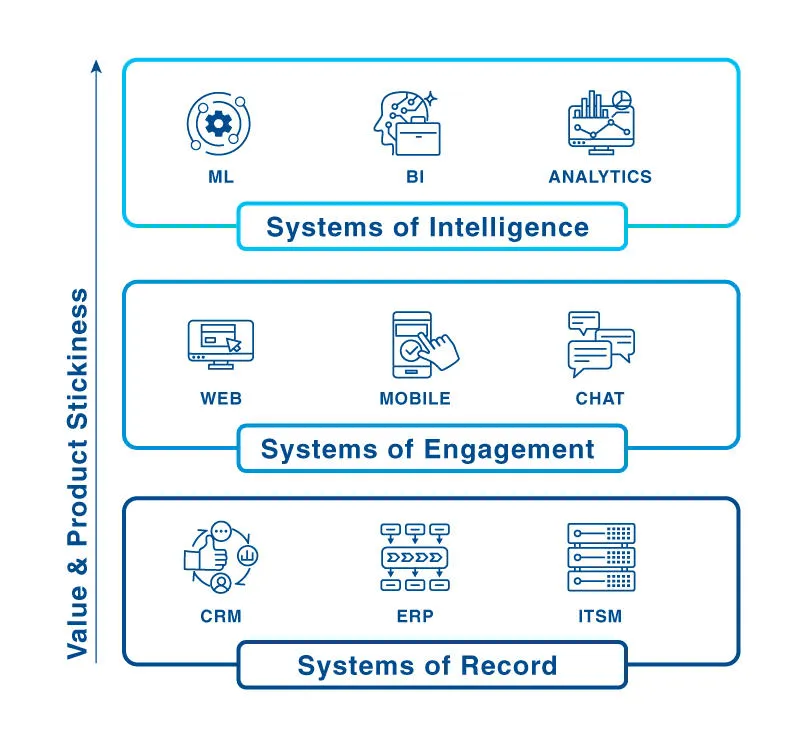
- From systems of record to systems of intelligence: In the past, the MarTech stack was divided into systems of record (SoR), which focused on data storage, e.g. CRM for customer data, and systems of engagement (SoE), which focused on customer interaction, e.g. email marketing. In the age of AI, this model is no longer sufficient and has therefore been expanded to include Systems of Intelligence (SoI) with the rise of machine learning. As a rule, these layers build on each other. Not least for generative AI and agentic AI, companies need a robust data foundation as a “system of context” for consistent, accurate data across all channels and products.
- Context is king in the age of AI: Generative AI enables highly contextualised, personalised user experiences in real time. This applies to both employees and end customers. Instead of static campaigns (‘one-size-fits-all’), systems of context now deliver dynamic content that adapts to the individual context of each customer or employee.
- From monologue to dialogue with the customer: Instead of playing predefined content, brands now engage in a genuine dialogue with customers via AI assistants. These concierge AI agents actively listen, utilise all available customer and company data, and provide exactly the information or services that are needed at that moment. Marketing thus becomes relevant in the moment–a shift from marketing assumptions about customer needs to the actual customer situation in real time.
- Strategic implications for executives: CDOs, CTOs, and executives must break down data silos and create a unified database, and not just now. CMOs and product managers must strategically integrate AI-driven personalisation to meet customer expectations. All executives are required to create organisational prerequisites (e.g. cross-functional AI governance, data governance) so that a “system of context” can create sustainable value within the company.
Introduction: MarTech in Transition Thanks to Generative AI
Marketing technology is evolving at a rapid pace. Generative AI (GenAI), i.e. AI models that can independently generate text, images, or other content, is fundamentally changing how companies produce content, interact with customers, and conduct marketing. For decades, it was common practice to divide MarTech platforms into two categories: “systems of record” such as CRM or customer data platforms, which served as the main source of data, and “systems of engagement” such as email automation, web CMS, or social media tools, which enabled customer contact. This model–data on one side, interaction on the other–worked for a long time, but became increasingly blurred. Even as recommendation engines, attribution models, and forecasting based on machine learning techniques were increasingly used by companies in marketing, there was talk of a “system of intelligence”.
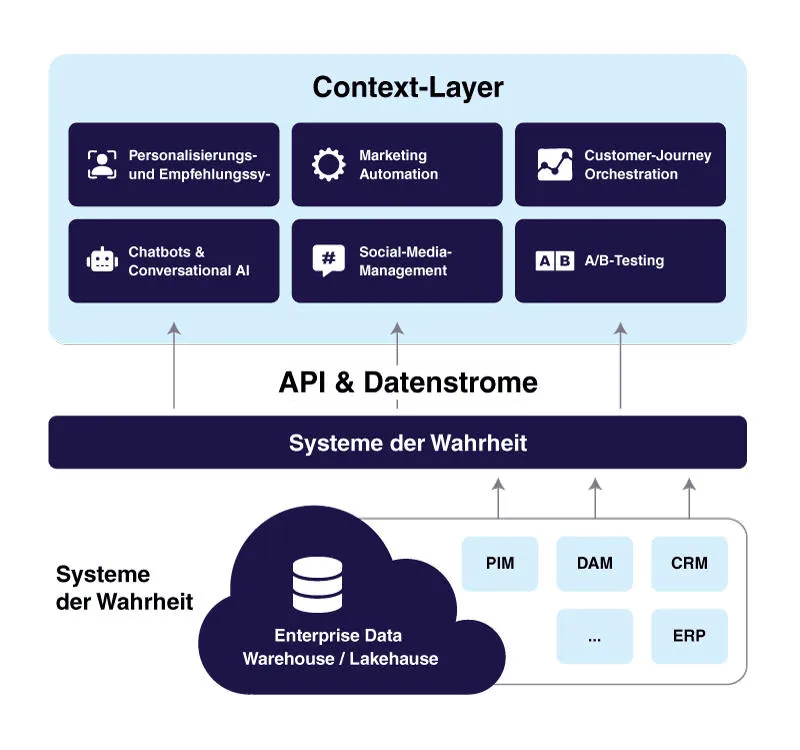
Of course, the diagram is only an abstraction, and these systems often flow into one another. For example, many CRM and CDP systems also offer marketing automation functions, so that data storage and interaction flow into one another.
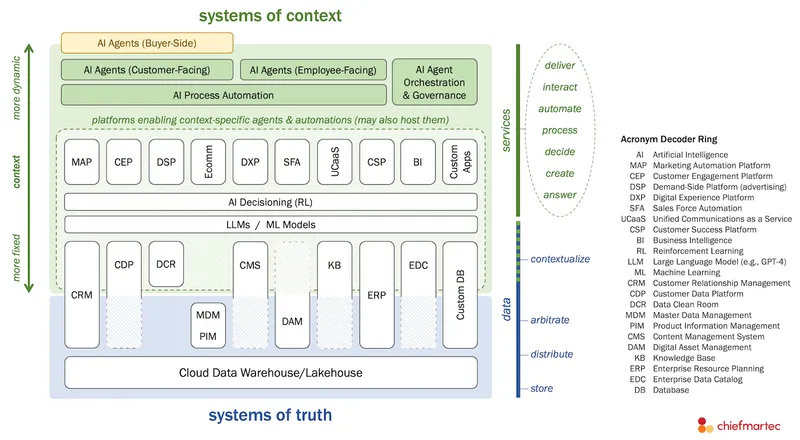
Today, in the age of ChatGPT, personalised recommendation systems, and AI assistants, this old division is reaching its limits. Marketing and customer experiences are increasingly shaped by AI in real time. Scott Brinker, a prominent figure in the MarTech field, therefore proposes a new model for the MarTech stack: “Systems of Context” and “Systems of Truth”. These new categories help to understand how data and AI-supported contexts will interact in the future to address customers at the right time in the right context.
“Companies that establish such a context system will remain competitive in the age of agentic AI.”
Systems of Truth, According to Scott Brinker: A Stable Foundation of Data
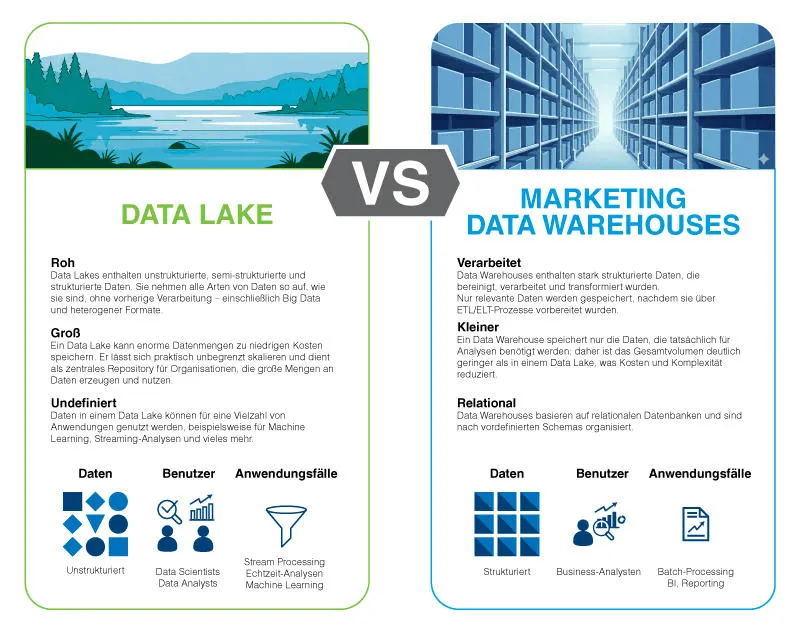
In order for AI to deliver personalised and contextually relevant content, it needs a reliable data foundation. This is where “systems of truth” come into play, i.e. the central data platforms on which all important company and customer data is consolidated and validated. In classic MarTech stacks, systems of record such as CRM (customer relationship management), ERP, or PIM took on the dual role of storing data and ensuring its quality. However, with the rise of cloud data warehouses and data lakes, modern enterprise architectures often separate pure data storage from data governance. A classic example is a data lake with a lot of raw data, but then a separate marketing data platform or reporting database with processed data for marketing or reporting use cases.
Although cloud data lakes (or lakehouses) can in principle, be used to create a “single source of truth” while in practice, so much heterogeneous data flows in (e.g. differing formats or definitions) that inconsistencies can arise. This means that specialised software is still needed above the data lake to define which data is considered valid and correct and how it is to be used consistently.
Proven MarTech systems such as CRM, MDM (Master Data Management), PIM (Product Information Management), DAM (Digital Asset Management), CDP (Customer Data Platform), or proprietary marketing data warehouses for proprietary data products, thus retain their raison d’être–albeit less as isolated data silos and more as “truth authorities” for specific data areas. These can be seen as referees who decide, for example, what constitutes a valid customer master data record, including definitions, validation rules, and workflows. Even if the actual data is physically stored in the data lake, CRM & Co. ensures that everyone in the company has access to reliable, consistent data.
The bottom line is that a single, monolithic ‘system of record’ as the sole source of truth for all company data is unrealistic, as business areas and data requirements are too diverse. Instead, today’s practice is to have many “systems of truth”, united by a common data layer. On this basis, companies can share data more effectively while controlling it on a domain-specific basis.
Example: A modern composable CDP (customer data platform) accesses the cloud data warehouse directly, but organises customer data for specific marketing contexts–for example, by combining customer lists with target group segments from advertising. Such CDPs help to generate campaign-specific target groups and insights from the general data pool.
In short, systems of truth form the stable data foundation in the AI era. Without clean, consistent data, even the best AI algorithms are of little use or offer no competitive advantage – on the contrary, incorrect or fragmented data leads to misleading results. CDOs and CTOs should therefore continue to invest in data integration platforms, master data management, and data governance. This layer is strategically essential: it ensures that all downstream AI and marketing applications have access to reliable information, i.e. the ‘truth’ in the stack.
Systems of Context, According to Scott Brinker: Dynamic Experiences Through AI-Driven Personalisation
The solid data foundation of the “system of truth” is where what becomes visible and experiential for your customers unfolds: the “systems of context”. This refers to all technologies that adapt and deliver customer experiences based on the situation–from personalised websites and AI chatbots to automated campaigns that are guided in real time by user behaviour. The decisive change here is the extent to which AI can and may individualise and dynamically generate these experiences.
Traditionally, systems of engagement, such as marketing automation or web content management, only offered a statically predefined context: marketers and product teams designed journeys, websites, or emails based on assumptions and hypotheses about what customers want or need.
Contextualisation was limited, and ultimately each customer received a variant from a predefined set of content. These interactions often resembled a monologue by the brand rather than a genuine dialogue with the customer. Generative AI is changing this dramatically. Now, numerous AI agents and micro-applications can be created that offer each customer or employee a tailor-made context and can act actively rather than passively.
Example: An AI-based chatbot in e-commerce can “assemble” itself individually for each website visitor based on their current behaviour (e.g. products viewed) and all historical data about that person. No hundreds or thousands of laboriously programmed rules to simulate a dialogue. For another visitor, the system may generate a different chatbot with a specific focus, such as technical support, if their behaviour indicates this. Many of these AI agents can exist in parallel, each focused on a specific task or usage context (product recommendation, customer service, onboarding, etc.).
This makes the interaction scalable and personalised: You no longer have just a rigid set of journeys, but potentially infinite variations that AI can generate on the fly.
It is important that these AI systems always draw on data from the “System of Truth”. Context-aware AI agents build on verified data and use it to tailor content correctly in the respective context. This creates a powerful interplay: The “System of Context” (e.g. an AI-driven personalisation algorithm) understands what a particular customer needs at any given moment and draws relevant knowledge from CRM, CDP & Co. to deliver exactly the right message or action at the right moment.
Another exciting future scenario is that both the customer and the company use AI agents that interact with each other. In the near future, a customer could use their own personal AI assistant to negotiate with the company’s AI systems on their behalf. This would shift the balance of power further towards the customer, as these buyer agents optimise the experience entirely from the customer’s perspective. Companies must therefore ensure that their context APIs are open and intelligent enough to provide meaningful responses to such external AI agents.
In summary, context systems form the agile and intelligent layer of your MarTech stack. They ensure that data is transformed into real customer experiences–highly personalised, context-sensitive, and AI-supported. For marketing and product managers, this means investing more in technologies that combine personalisation, automation, and AI.
The MatTech architecture of the future is thus transforming from a rigid layer model to a flexible network of integrated services. Although a stack can still be represented logically (see Fig. System of the upper layer context), in reality the components communicate with each other in a versatile manner, as in a network. Each system can be connected to every other via interfaces and middleware in order to exchange data or triggers. The systems of truth form the central hub around which numerous systems of context are grouped.
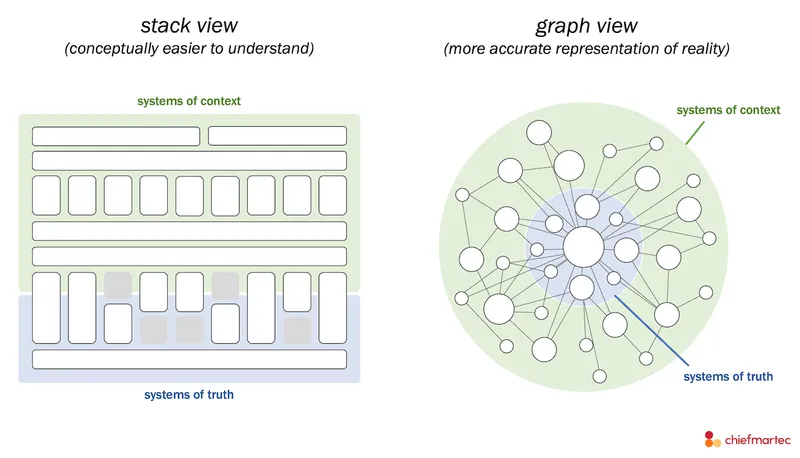
For a company’s IT architecture, this means that interoperability and data integration are critical to success. A context system can only be as good as the data it can retrieve at any given moment.
In short, the architecture of a MarTech stack in the GenAI era is more like an organic ecosystem than a rigid structure. Companies should strive for a modular, scalable solution design where new AI components can be easily integrated and data can be shared seamlessly. This ensures that innovation does not fail due to silos, but quickly takes effect across the entire stack.
Excursus: Context Engineering Explained Briefly
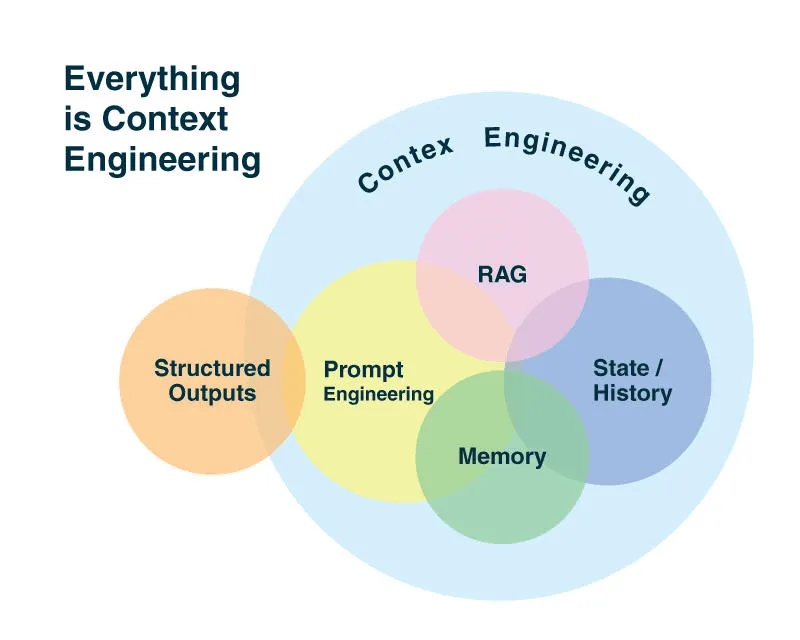
Context engineering designs systems that control which information an AI model sees before responding, rather than just formulating individual prompts. It orchestrates system prompts or instructions, conversation history, and user data, relevant documents/DB entries, available tools & APIs, and desired output formats in the context window so that the most relevant details are available in a compact and orderly manner for each request.
Distinction: Prompt engineering optimises the formulation for one-off tasks; context engineering builds application logic for multi-step, long-lasting workflows (e.g. service bots, document analysis, coding assistants). Both are most effective when used together: strong prompts on carefully curated context.
In practice: Typical building blocks are Retrieval-Augmented Generation (RAG – retrieval →chunking →ranking), AI agents with access to tools (possibly via MCP (Model Context Protocol) servers), and code assistants that take project structures into account.
Common Problems That Good Context Engineering Solves
Context poisoning, when errors or hallucinations appear in the AI context.
The ideal strategy is context verification and quarantine. This involves isolating different types of context in separate threads to verify information before it is transferred to long-term memory. Context quarantine means that new threads are started in the event of potential “poisoning”. This prevents erroneous information from influencing future interactions.
Context diversion occurs when the context becomes so extensive that the model focuses too much on the collected data instead of applying what it has learned from training. Models tend to repeat content from the context – according to studies, even before the context window is fully utilised. (Study by Databricks – LLM Performance)
Summarise the context to shorten it. This helps to maintain an overview and avoid unnecessary details.
Context confusion occurs when you add additional information to the context, which the model then uses to generate incorrect answers, even if this information is not relevant to the current task. This happens, for example, when the AI agent uses the wrong tool.
The solution is to manage the tools for AI agents with RAG techniques and to integrate tools via the Model Context Protocol (MCP).
Context conflict occurs when AI agents access contradictory or incompatible statements. Models are particularly prone to this when everything is processed at once, i.e. in a single prompt. This means that it responds before it has all the relevant information.
The best solutions are to clean up the context and offload it. Context cleaning means deleting old or contradictory information when new details emerge. Context offloading or similar approaches.
Conclusion and Recommendations for Executives
The introduction of a “system of context” in the MarTech Stack is not purely a technical project; it is a strategic realignment that requires leadership on multiple levels. In the age of generative AI, the companies that will be successful are those that intelligently combine data and AI to create customer-centric, contextual experiences.
Scott Brinker’s model serves as a good guide and shows a new possible model consisting of two layers, “System of Truth” and “System of Context’” the latter of which is not a technical layer. When considering the technical components necessary to feed AI with contextual data, the “System of Context” can also be seen as an extension of the classic model of “System of Records”, “System of Engagement”, and “System of Intelligence”.
New disciplines are emerging, such as context engineering, and technologies such as Model Context Protocol (MCP), Agent-to-Agent Protocol (A2A), Retrieval-Augmented Generation (RAG), Agentic AI, and Agentic RAG. As many of these disciplines are still relatively young, it is foreseeable that a lot will change technologically and that new technologies may already be on the rise.
Regardless of the model, here are a few recommendations on how managers and other decision-makers can shape this change:
- Prioritise data quality and governance: Lay the foundation with a robust “System of Truth” data layer. Invest in data integration, authorisation concepts, cleansing, and uniform data standards. Establish clear responsibilities (data owner, stewardship) so that AI can later access confidential and up-to-date data. A central data strategy is a matter for senior management, as it forms the backbone of all AI activities.
- Build AI skills and resources: “Systems of Context” require new skills and technologies. Ensure that data science and AI expertise are available in or for the marketing team. Consider setting up a cross-functional AI steering committee (with representatives from marketing, IT, product, legal, and compliance) to guide the use of AI and share best practices. This will ensure that data protection, ethics, and brand consistency are maintained even with AI-generated content.
- Start gradually and experiment with agility: Begin with focused pilot projects to test the context principle. For example, an AI-powered assistant in the marketing team or a personalised product recommendation AI in the online shop. Measure the impact (e.g. customer satisfaction, conversion lift, interaction rates) and then scale successful approaches more broadly in the stack. Quick wins help to create internal acceptance for larger changes. Don’t forget a go-to-market strategy so that it doesn’t remain at the POC or pilot stage.
- Expand your technology stack modularly: Check your existing MarTech stack for integration capability. Can your CRM and marketing tools share data in real time? Do they already offer MCP servers? Can external AI services be docked? Preferably, rely on API-first solutions that can be flexibly integrated into the context system. It is important that new AI modules communicate seamlessly with your data sources and channels.
- Think radically about customer centricity: Use the possibilities of AI to truly communicate with customers on an equal footing. Move away from scattergun marketing towards tailored conversational marketing: every interaction, whether in chat, by email, or on the website, should ideally take into account the customer’s current context. Ask yourself: “Are we offering the customer exactly what they need at this moment?”, “How can I measure and continuously optimise this?”. If you have implemented a “system of context”, you can already answer this question with yes, because your AI-supported touchpoints will be trained to be contextually relevant and helpful.
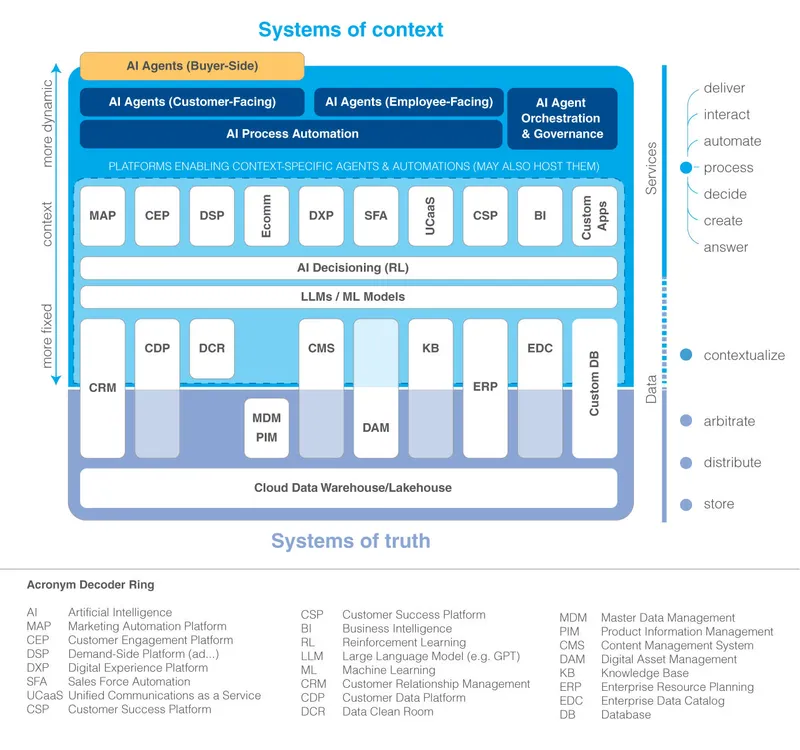
In conclusion, the MarTech stack of the future is based on context and truth. Data is the “truth capital” that a company must have under control. Around this, AI is developing a context ecosystem that is revolutionising marketing, sales, and service. Companies that adapt this architecture early on will win customers with better, more relevant experiences and increase internal efficiency through automation.
The key challenge for executives is to harmonise technology, data, and organisation. If they succeed, the “system of context” will become a success factor in their MarTech stack of the future.
Sources: The conceptual ideas for systems of context and systems of truth come from Scott Brinker. Other sources and inspiration include industry-specific analyses of the role of AI in marketing and our own projects with customers.