


In today’s business world, you constantly hear the term “B2B marketing.” But what exactly does it mean? What are its key components—and which strategy is the right one?
When we talk about B2B marketing (short for “business-to-business”), we’re referring to the marketing process by which one company informs another about its products and services. Unlike B2C (business-to-consumer) marketing, B2B targets decision-makers within companies – not individual consumers. This means that strategies must be geared toward building long-term, trusting relationships, with a clear focus on ROI, performance measurement, and valuable, informative content.
In a competitive, digitalized market, a structured and data-driven marketing strategy is essential for effectively positioning your business. Let’s take a look at the key components of a successful B2B strategy—and how data plays a crucial role.
Key components of a B2B marketing strategy
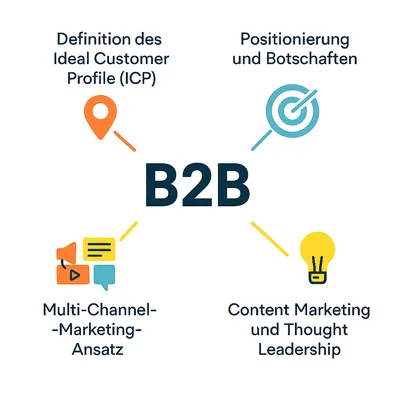
This image was generated by AI.
Definition of the Ideal Customer Profile (ICP)
An ideal customer profile is a detailed description of the company that would derive the greatest benefit from your solution – and thus deliver the highest return. This typically includes factors such as industry, company size, revenue, location, and decision-making structure. In B2B marketing, it’s crucial to know exactly who you want to reach. This ensures that your messaging, campaigns, and sales efforts are aligned and effective.
Positioning and messaging
The way you position your brand determines how your solution stands out from the competition in a competitive market. Effective B2B communication should focus on business-critical outcomes such as cost reduction, efficiency improvement, revenue growth, or risk minimization – while always keeping the long-term goal in mind.
Multi-channel marketing approach
Successful B2B strategies utilize a mix of digital and offline channels, e.g.:
- LinkedIn: for professional networking and paid advertising, supplemented by other social media platforms like Instagram or Facebook to strengthen brand identity
- Email campaigns and newsletters: to engage and inform current and potential customers
- Google Ads and SEO: to generate high-quality leads and increase reach
- Industry events and webinars: for thought leadership and building personal relationships
It is important that each channel plays a clear role in the customer journey – and that you can measure performance across channels to find out what works best for your business.
Content-Marketing and Thought Leadership
Ultimately, content is at the heart of B2B marketing. Use your website and media channels to demonstrate authority, trust, and expertise—for example, through blogs, white papers, or case studies. By providing insights into solving real business challenges, we position ourselves as a valuable partner—not just a service provider.
The role of data and analytics in B2B marketing – and at Digital Loop
Another key element in developing a B2B strategy is data. In the B2B sector, data and analytics form the foundation for an effective, scalable strategy based on real numbers.
Whether you’re launching a LinkedIn campaign, optimizing your SEO strategy, or personalizing an email follow-up process, data ensures relevance, precision, and ROI. Tools like Google Analytics, CRM systems, and marketing automation platforms help you monitor user behavior, segment target groups, and analyze what works—and what doesn’t—throughout the entire process.
At the same time, data also serves as proof of your performance to customers—building trust through transparent, measurable results.
But collecting data isn’t enough. It also needs to be interpreted and used correctly. Many companies struggle with this – especially when working with multiple platforms that aren’t well integrated. That’s why at Digital Loop, we place great emphasis on data protection-compliant, consent-based strategies, complemented by clear dashboards and transparent KPIs. We help our clients track what truly matters: conversions, cost efficiency, and long-term value – ethically and effectively.
How do we put this approach into practice?
At Digital Loop, we work with a practical strategy:
- We actively participate in industry events to stay connected with the latest trends.
- We run SEO campaigns tailored to each client’s specific goals.
- We send targeted cold-calling emails to reach the right people at the right time.
- And we regularly share insights and thought leadership on LinkedIn to foster exchange, updates, and guidance within the community.
What truly sets us apart are our tailored MarTech solutions. Our tools help clients thrive in highly competitive markets. For example, we developed the AI Overviews Analyzer – a tool that allows our clients to monitor developments in Google’s AI Overviews and react more quickly and intelligently to daily changes.
Conclusion
Successful B2B marketing is much more than publishing content or running campaigns. It requires a structured yet flexible strategy—grounded in data, aligned with business objectives, and open to a constantly evolving market.
Define your ideal customer. Craft your message clearly. Choose the right platforms. Test, track, and optimize. No strategy is perfect from day one—but with the right mindset and the right tools, it can continuously improve.
Want to learn how AI-powered insights can enhance your B2B marketing? Let’s talk – now.