

Search engine optimization (SEO) has evolved significantly in recent years, primarily for two reasons: the rise of generative AI such as ChatGPT and Gemini, and several core and spam updates from Google. SEO strategies that were effective 3-4 years ago no longer work. The competition for top positions in the SERPs has reached new heights.
According to clickstream data from Datos (a SEMrush company), Google directs around 30% of all clicks in the US and EU to its own affiliated websites.
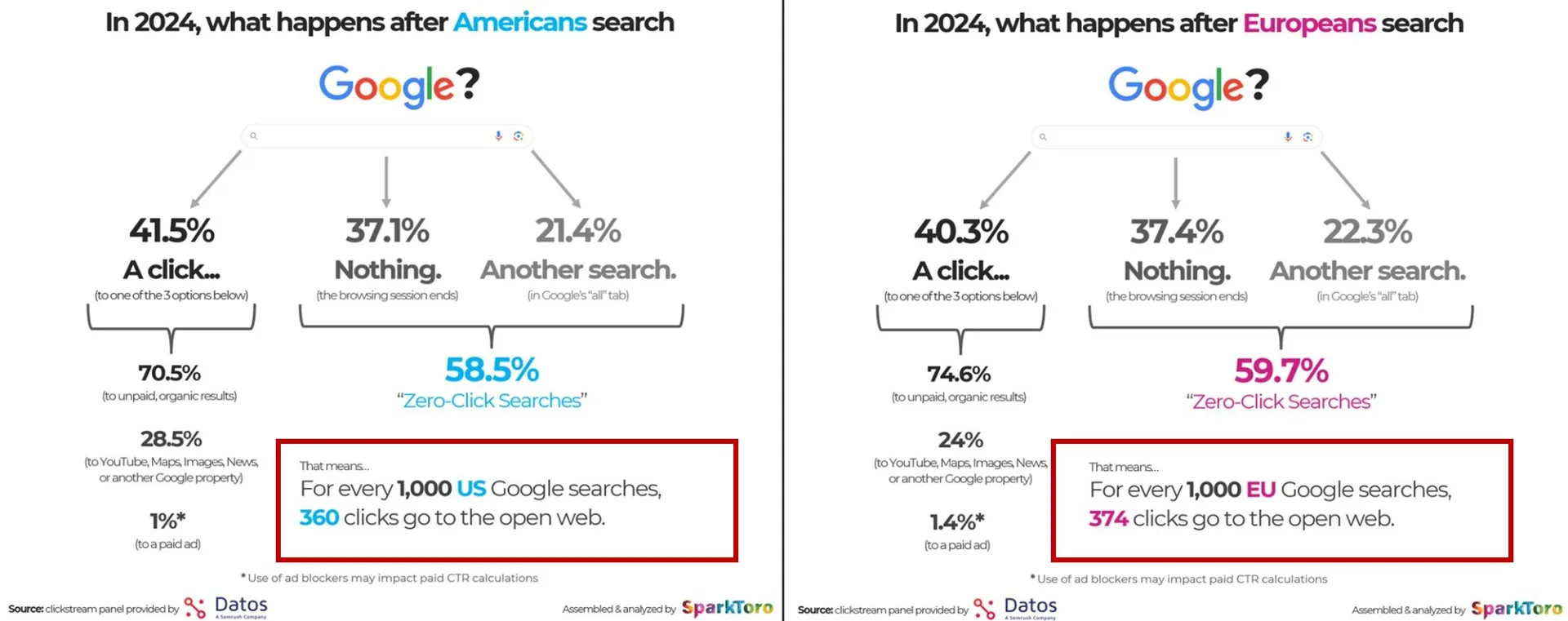
Image source: sparktoro
For major brands today, staying ahead of the competition is more than just a goal. It’s essential to ensure their websites attract high traffic, as the value of online shopping worldwide is projected to exceed $4.1 trillion by the end of 2024 (Statista).
Brands can develop more effective SEO strategies for higher SERP rankings and improved conversion rates by understanding their competitors and their strategies. However, competitor analysis is more than simply examining the strategies your competitors are using. It’s a continuous process of learning, improvement, and identifying opportunities to do even better next time.
Digital Loop is proud to partner with several DAX-listed companies to provide enterprise-level SEO and analytics solutions that drive growth and maximize visibility. We believe it’s time to share our knowledge and experience in enterprise SEO with the SEO community.
The journey begins with a series of blog posts (three in total) on competitor analysis for businesses. This guide is designed to help you increase traffic by outperforming your competitors in search engine results pages (SERPs), capturing more leads, or boosting your conversion rate. In this first part of our series on business competitor analysis, you’ll learn about the fundamentals of business SEO, why competitor analysis is so important, and how to select the right competitors. We’ll also provide you with a 9-step checklist to help you identify the best SEO competitors for your business. The topics we’ll cover include:
- What is Enterprise SEO?
- How Enterprise SEO differs from traditional SEO
- Why competitor analysis is crucial for your SEO success
- Identifying your Enterprise SEO competitors
- SEO checklist for identifying competitors
- Top 7 competitor SEO tools for enterprises
What is Enterprise SEO?”
Enterprise SEO refers to a specialized approach to search engine optimization that aims to improve the visibility of large websites in search engines, typically for large brands or companies. At Digital Loop, we address them as enterprise clients. Enterprise clients have large websites with thousands to millions of pages, complex structures, and extensive content. For example, apple.com is a large company, and this is what its website looks like.

Image: Screenshot from apple.com
Apple has around 127 million indexed pages in Google! That’s an insane number, isn’t it? An extremely large website like Apple.com naturally has different needs because it faces different challenges than a non-branded website with less authority.
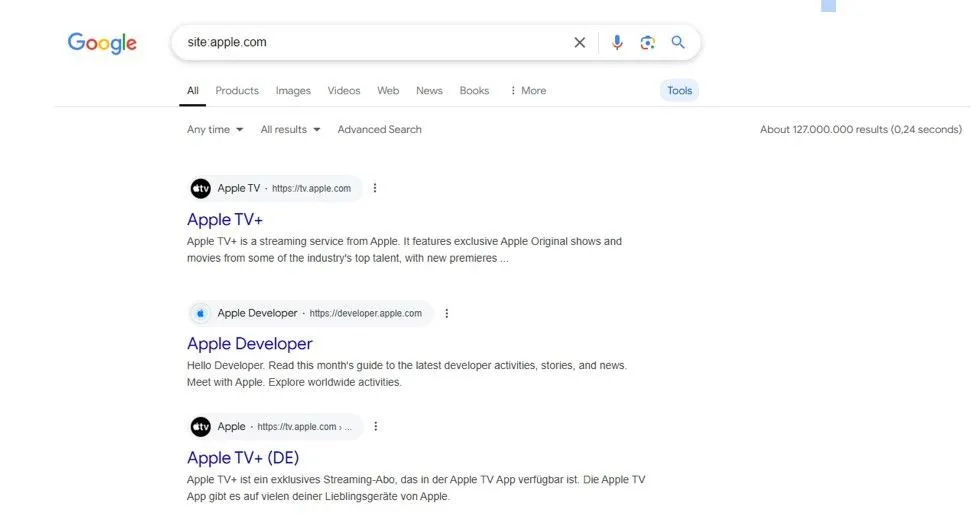
Image: A screenshot from the SERP for apple.com to show how many pages it has.
Therefore, enterprise SEO focuses on the unique challenges or complications that large brands typically face when managing millions of web pages, processing massive amounts of data, targeting multiple regions or languages (also known as international SEO), and competing with other large brands for broad keywords like home or car insurance. Now, it might seem like we’re only talking about challenges. Large brands also enjoy certain advantages thanks to their greater authority, brand value, expertise, and long-standing experience, such as EEAT. You guessed it. EEAT stands for Experience, Expertise, Authoritativeness, and Trustworthiness.
To learn more about EEAT and how it affects your ranking in the SERPs, read our latest blog post “EEAT: What does Google’s concept mean for SEO?“.
How Enterprise SEO differs from traditional SEO
As we’ve already discussed, the main difference between enterprise SEO and traditional SEO lies in the scalability, complexity, and strategic approach that large companies can take when managing their extensive websites, diverse products, and intense competition. Enterprise clients have larger SEO budgets and therefore seek automation, sophisticated web-based tools capable of crawling millions of pages, and technical support.
In contrast, traditional SEO focuses on niche markets and long-tail keywords. Clients who opt for traditional SEO typically have comparatively smaller websites with a few hundred to a few thousand pages. They often serve only one language and one region and therefore don’t need to worry about international SEO. Here are the key differences:
1. Scope of the website and the pages
Enterprise SEO: This typically involves clients with large websites containing thousands or even millions of categories, subcategories, and product pages. Enterprise websites often have complex data structures and include multiple subdomains, a shop/marketplace, and a variety of content pages such as blogs, service pages, and product listings.
Traditional SEO: This primarily applies to small to medium-sized websites, which generally have a few thousand pages and a comparatively less complex website architecture.
2. Content Strategy
Enterprise SEO: Business clients typically serve multiple languages and regions. Therefore, they must adhere to brand guidelines and adopt a strategic approach to tailor content to the needs and behavior of their local audience.
Traditional SEO: On the other hand, traditional SEO focuses on creating and optimizing content for a more specific or local audience, targeting particular niches with low competition and long-tail keywords.
3. Technical SEO
Enterprise SEO: Enterprise clients utilize multiple platforms and place greater emphasis on scalability, SEO process automation, and the management of complex website structures. Optimizing performance, crawlability, and indexing for thousands of pages are their technical SEO priorities.
Traditional SEO: This addresses comparatively simpler technical issues such as website speed optimization, ensuring mobile-friendliness, fixing broken links, checking URLs, response codes, etc.
4. Keyword Targeting
Enterprise SEO: As mentioned earlier, corporate SEO focuses on a broad range of keywords and often targets different industries, regions, and languages. Corporate websites typically have enormous traffic from brand-related keywords. This doesn’t mean they don’t use mid-tail or long-tail keywords. They mix them with broad keywords to capture more specific needs of the target audience.
Traditional SEO: Keyword research plays a more significant role here due to the lower authority and brand value. The goal is to find a less competitive niche and create content using long-tail keywords, which have a comparatively higher search volume but less competition.
5. Ressources and Tools
Enterprise SEO: This involves using advanced, enterprise-level SEO tools like Lumar (formerly known as DeepCrawl), SeoClarity, BrightEdge, Semrush Enterprise, Ahrefs, Botify, Screaming Frog, and others to crawl websites with millions of pages, track performance, automate workflows, and manage large-scale campaigns across multiple platforms or regions.
Traditional SEO: This typically relies on comparatively smaller, more affordable tools like Moz, Keyword Finder, SEMrush, and Ahrefs, designed for less complex projects. You’ve probably noticed Ahrefs on both sides. Well, we couldn’t resist, because all SEO marketers love Ahrefs.
6. Competition
Enterprise SEO: We already know that corporate websites target broad keywords and therefore face stiff competition from other large companies. To mitigate this competition, they tend to increase their authority, build strong backlink profiles, and significantly improve user experience.
Traditional SEO: This doesn’t mean that traditional SEO is without competition. Traditional SEO clients invest heavily in keyword research and niche selection to identify less competitive search queries and industries.
7. Reporting and Metrics
Enterprise SEO: Regular website audits and reports deserve special attention when managing corporate websites. Often, separate reports are generated for different business units in different countries under the same brand name. Such an audit includes both content SEO and technical SEO metrics.
Traditional SEO: However, reporting for smaller websites is generally simpler and focuses more on key metrics such as traffic, rankings, conversions, and local visibility.
Difference between Enterprise SEO and traditional SEO
| Factor | Enterprise SEO | Traditional SEO |
|---|---|---|
| Website Size | Thousands to Millions of Pages | Hundreds to Thousands of Pages |
| Content Strategy | Multiple Languages and Regions | Usually a Single Location and a Single Language |
| Technical SEO | Covers Complex Technical Issues | Covers Comparatively Simpler Technical Issues |
| Keyword Targeting | Mostly target broad keywords | Primarily target long-tail keywords |
| Resources and Tools | Use cloud-based, advanced, enterprise-level SEO tools | Use smaller and less expensive tools |
| Competition | Extreme competition | Comparatively less competition |
| Reporting | More frequent and detailed | Less frequent and comparatively simpler |
Why competitor analysis is crucial for your SEO success
Well, the answer is quite simple. You need to conduct thorough competitor analysis to understand your competitors and outrank them in the SERPs so your website gets the most traffic for specific search queries. If you do it right, you can uncover content or keyword gaps in your current strategy and identify growth opportunities. Search query or keyword research is one of the most important parts of competitor analysis, which we’ll discuss later.
Advantages of competitor analysis for SEO
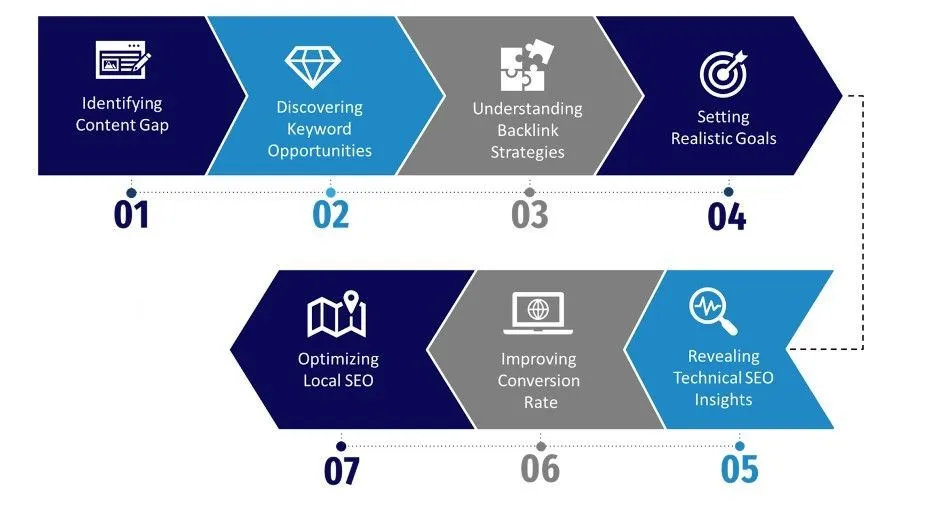
Image: Benefits of competitor analysis for SEO
By conducting a proper competitor analysis, you can expect:
- Identify content gaps that you haven’t yet addressed, but for which your competitors are already ranking.
- Uncover search queries or keywords with high search volume and low competition.
- Find the list of referring domains your competitors have used for inbound backlinks. Later, you can measure their strengths and weaknesses and create your own list.
- By comparing your website’s SEO performance metrics, such as rankings, traffic, user engagement, etc., with those of your competitors, you can set realistic goals and track progress over time. This allows you to see where you stand in the market and what steps you need to take to improve.
- You can also gain technical SEO insights from your competitor’s website, such as website speed, central web vitality, mobile-friendliness, and structured data. Later, you can use this information to optimize your own website for better performance and ranking.
- By comparing how your competitors organize their landing pages, calls to action, and metadata, you can also gain insights into how to improve your website’s conversion rate.
- If your business or business client focuses on the local market, competitor analysis can help you understand which keywords your competitors rank for locally, what tactics they use for local listings, and how strong their customer reviews are.
Identifying your enterprise SEO competitors
Before analyzing your competitors’ websites, you need to identify and compile a list of your direct and indirect competitors. Direct competitors are companies that offer similar products and services, while indirect competitors may not offer similar products or services. However, they can still be relevant because they rank higher in search engine results pages (SERPs) for similar search terms. For example, a tech blog doesn’t sell phones but can publish reviews of phones and thus achieve a higher ranking for informational and commercial search terms.
Take a look at the following screenshot. Here, we searched for one of the most popular queries: “Best SEO service” on Google. Surprisingly, Forbes comes out on top, even though they don’t offer SEO services and the search query is commercial, not informational. In this case, Forbes, as an SEO agency, is our indirect competitor.
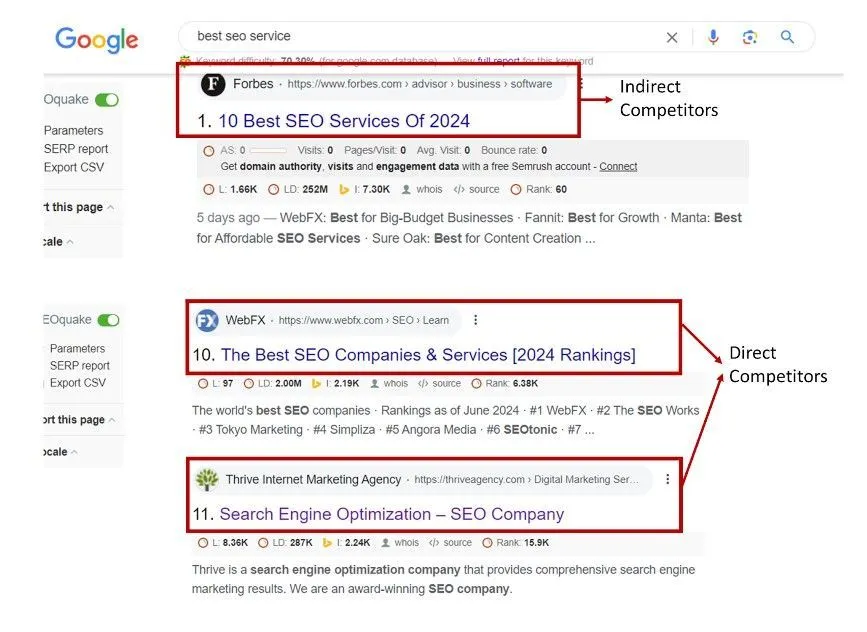
Image: Indirect SEO competitors versus direct SEO competitors
SEO checklist for identifying competitors
For a complete list of your direct and indirect competitors, see our 9-step guide.
Step 1: Identify your target keywords
- Brainstorm and find a keyword for each product or service you offer. Don’t focus on the competition at this stage. Simply gather one broad keyword for each product or service that has a high search volume.
- Now enter your keywords into SEO tools like Ahrefs, Google Keyword Planner, or SEMrush, and you’ll get a long list of related, relevant keywords. For each product or service, select the three most suitable keywords that have a relatively high search volume.
Step 2: Perform Google searches
- Search for each keyword on Google and note the 10 most important websites that appear in the organic results.
- Create a table listing these competitors for each keyword. In one column, indicate whether they are your direct or indirect competitors.
Step 3: Use SEO tools to identify competitors
- Use Ahrefs, SEMrush, or Moz to identify other competitors ranking for similar keywords and enter their information into the same spreadsheet.
- Export competitor data such as keyword overlap and domain authority. Different tools have different metrics; Ahrefs, for example, calls it domain ranking.
Step 4: Analyze competitor metrics
- Check each competitor’s Domain Rating (DR) and backlink profiles using Ahrefs. If you use SEMrush, you’ll see another term called Authority Score (AS).
- Summary your competitors’ strengths, such as backlinks, traffic, keyword count, and on-page SEO.
Step 5: Check for local competitors (if applicable)
- Perform a local keyword search (e.g., “plumber in [city]”) and note the local businesses that appear in the rankings. Check if they also use local information, such as their location, in their meta tags.
- Add local competitors to your spreadsheet if you are targeting a specific geographic area.
Step 6: Analyze the content of your competitors
- Analyze your competitors’ content for structure, length, and type (blogs, guides, case studies). A website with long, comprehensive content will generally rank higher. Conversely, a website with short content is comparatively easier to outrank in the SERPs.
- Use tools like BuzzSumo to see which content performs better. You can also use traditional SEO tools like Ahrefs to see how well your content is performing.
Step 7: Examining the competitors’ backlinks
- Use Ahrefs, SEMrush, or Majestic to investigate where your competitors are sourcing their backlinks. In 2024, SEO professionals should focus on the quality and relevance of backlinks rather than quantity, as irrelevant backlinks and backlinks from spam websites offer little to no value.
- Identify opportunities for your own link-building strategy.
Step 8: Monitor competitor website updates
- Use tools like Visualping to track changes on competitors’ websites.
- Check these changes regularly to stay up-to-date on your SEO strategy.
Step 9: Refine your SEO strategy
Based on competitor analysis, adapt your own SEO approach by identifying keyword gaps, content opportunities, and backlink targets.
Top 7 Competitor Analysis Tools for Enterprises
We will now present our 7 best SEO tools for competitor analysis, which you can use in your next project. The order in which you will see the tools is arbitrary, as we want to compare them.
1. Lumar
Lumar, formerly known as Deepcrawl, is one of the most popular enterprise SEO solutions for major brands and consulting agencies. Lumar enables large companies to maintain high technical standards across very large website structures thanks to its scalable crawling capabilities. Lumar offers website auditing, tracking, migration, and testing features to ensure maximum crawling efficiency and improved usability.
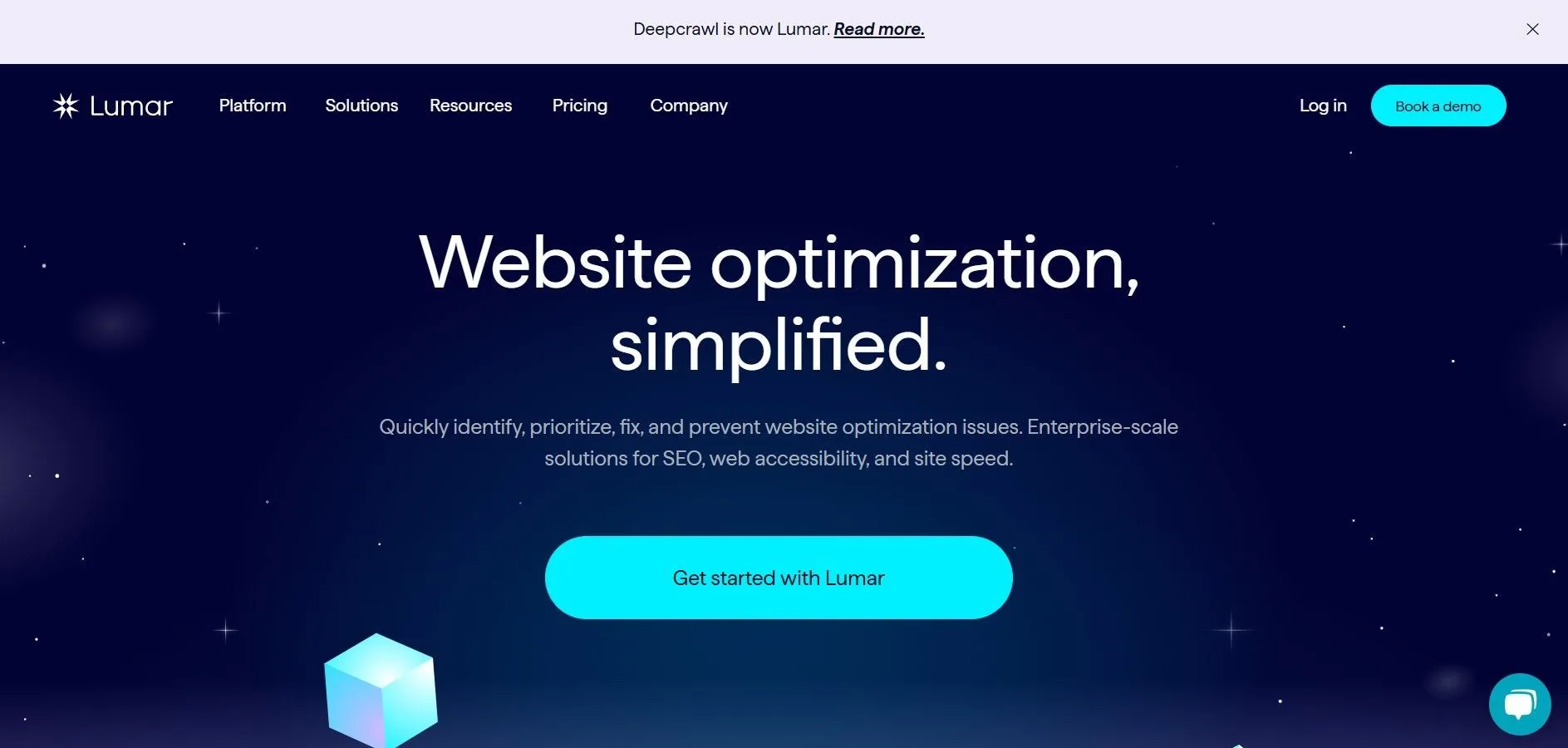
Image: Lumar
Advantages and disadvantages of Lumar
Using Lumar has several advantages and disadvantages. Let’s discuss some of them below:
Advantages of Lumar:
- 100% cloud-based, so you don’t have to overload your laptop/PC
- Offers fast crawling and error detection and is especially good for technical SEO
- Easy navigation with an excellent user interface
- Detailed reporting
Excellent notification system
Disadvantages of Lumar
- Sources of error are not always clearly identifiable.
- Lack of transparency, as the price is not listed on the website.
- There is a learning curve, and the tool may seem overwhelming at first.
- Quite expensive.
How much does the SEO tool Lumar cost for businesses?
Lumar’s price depends on the number of URLs you want to crawl. According to some sources, the Analyze plan costs $32,000 per year, which is about $2,667 per month. It seems they treat pricing as confidential information, and therefore we were unable to verify this data. To find out the exact pricing, you can book a demo here.
2. Ahrefs
Ahrefs has been one of the most reliable tools for SEO professionals for years. The tool is renowned for its comprehensive backlink analysis and insights into content performance. It offers rank tracking, gap analysis, and site audit features that are invaluable for enterprise SEO in improving organic visibility and conducting comprehensive competitive analysis.
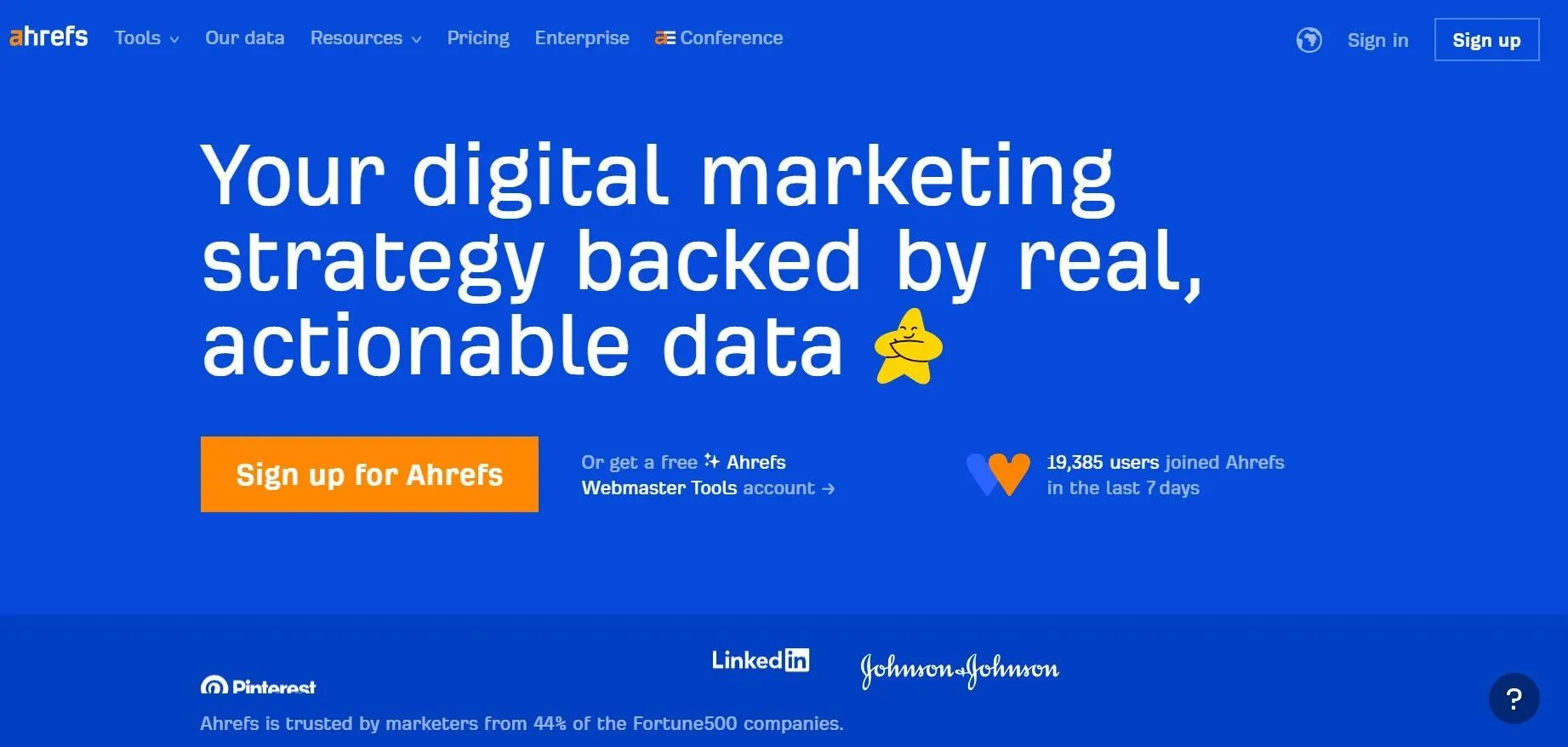
Image: Ahrefs
Advantages and disadvantages of Ahrefs
Using Ahrefs has several advantages and disadvantages. Below, we’ll explore some of them:
Advantages of Ahrefs
- One of the best keyword research tools on the market
- Higher data accuracy
- Comprehensive backlink analysis
- Competitor analysis for keywords, referring pages, and referring domains
- User-friendly interface
Disadvantages of Ahrefs
- Does not show traffic originating from non-branded keywords
- Limited technical SEO features
- Limited local SEO data
How much does the enterprise SEO tool Ahrefs cost?
Ahrefs offers four project-based SEO packages to suit different needs. The packages are “Lite,” “Standard,” “Advanced,” and “Enterprise.” The Enterprise SEO package costs $13,940 per year, which is approximately $1,162 per month, and allows the creation of up to 100 projects.
3. Semrush Enterprise
Semrush is another popular choice when we talk about SEO tools. Today, we’ll be discussing Semrush Enterprise, which was released in late 2023 and immediately made waves in the SEO community. Semrush Enterprise focuses on three unique aspects: content strategy, technical SEO, and link building. Semrush offers additional layers for data processing, collaboration, and custom reporting, enabling large companies to seamlessly integrate SEO insights into their broader digital marketing strategies.
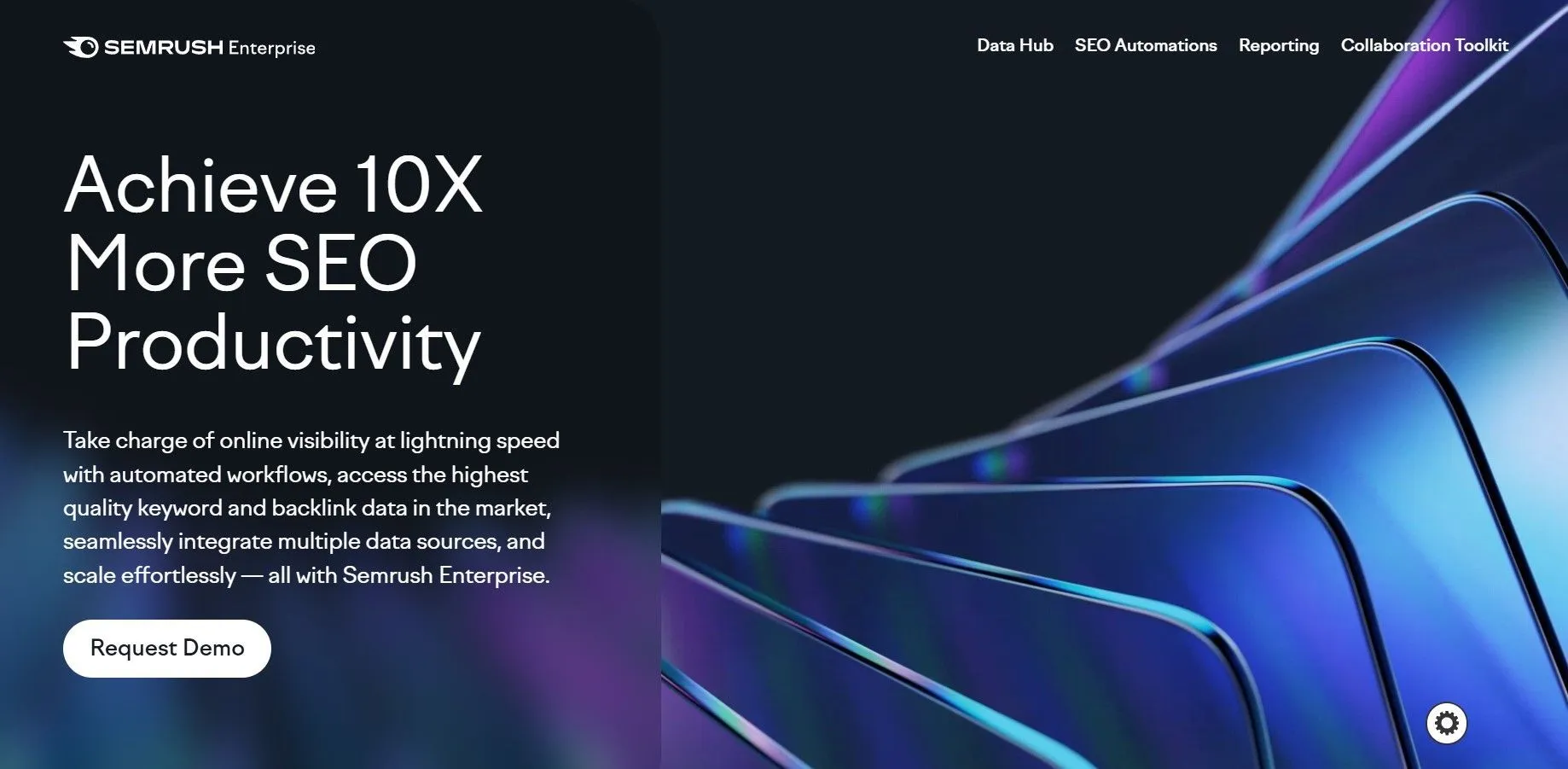
Image: Semrush
Advantages and disadvantages of semush
Using Semrush has several advantages and disadvantages. Let’s discuss some of them below:
Advantages of Semrush:
- 100% cloud-based, so you don’t have to overload your laptop/PC
- Show all traffic received from non-branded keywords
- Excellent for keyword and backlink analysis
- Simple and easy-to-use interface
- Regular updates and high data accuracy
- A comparatively more affordable option
Disadvantages of Semrush
- Not good enough for a technical SEO audit.
- The backlink analysis is good, but sometimes delivers irrelevant results.
- Limited functionality, as the tool focuses heavily on the paid add-on.
How much does the SEO tool Semrush cost for businesses?
Semrush charges $139.94, $249.95, and $499.95 respectively for its Pro, Guru, and Business packages. However, they’ve decided to keep the cost of their new flagship tool, Enterprise SEO, a secret. To find out the exact pricing, you can request a demo here.
4. seoClarity
SeoClarity is another enterprise-level SEO tool that leverages the power of automation and data-driven insights to streamline large-scale SEO processes. The tool features Sia, an AI assistant powered by ChatGPT, which can help optimize content, automate tasks, and identify technical issues at the enterprise level.
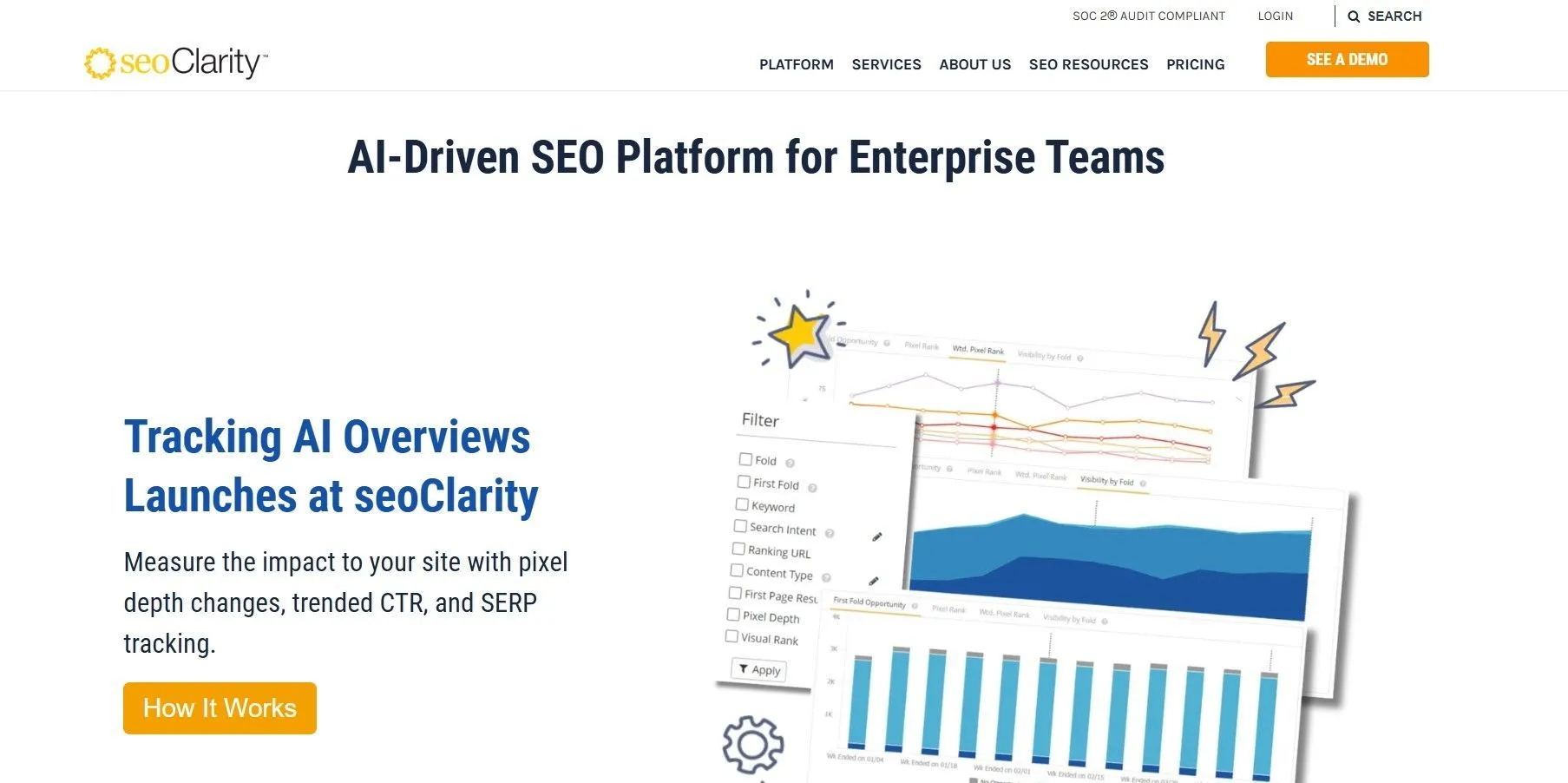
Image: seoClarity
Advantages and disadvantages of SeoClarity
Using SeoClarity has several advantages and disadvantages. Let’s explore some of them below:
Advantages of SeoClarity:
- Generative AI-powered insights
- Great for technical SEO audits
- The tool is scalable and has its own support
- Offers a feature for detailed data analysis
- Great software to keep if you’re test-oriented
Disadvantages of SeoClarity:
- Steep learning curve, as the tool can seem overwhelming at first.
- It can become expensive for small businesses or agencies.
How much does the SEO tool SeoClarity cost for businesses?
SeoClarity offers four SEO packages: Ranking, Research & Content, Technical SEO, and Enterprise. The Enterprise SEO package starts at $3600. To learn more about the pricing of the other packages, please visit SeoClarity.
5. Screaming Frog
You can think of Screaming Frog as the helpful neighbor you can always call on for assistance with off-page, on-page, or technical SEO issues. It’s capable of efficiently crawling large websites to uncover critical SEO problems such as missing or duplicate meta tags, broken links, duplicate content, and more across thousands of pages. Furthermore, you can connect Screaming Frog to Google Analytics and Google Search Console to gain valuable insights when needed.
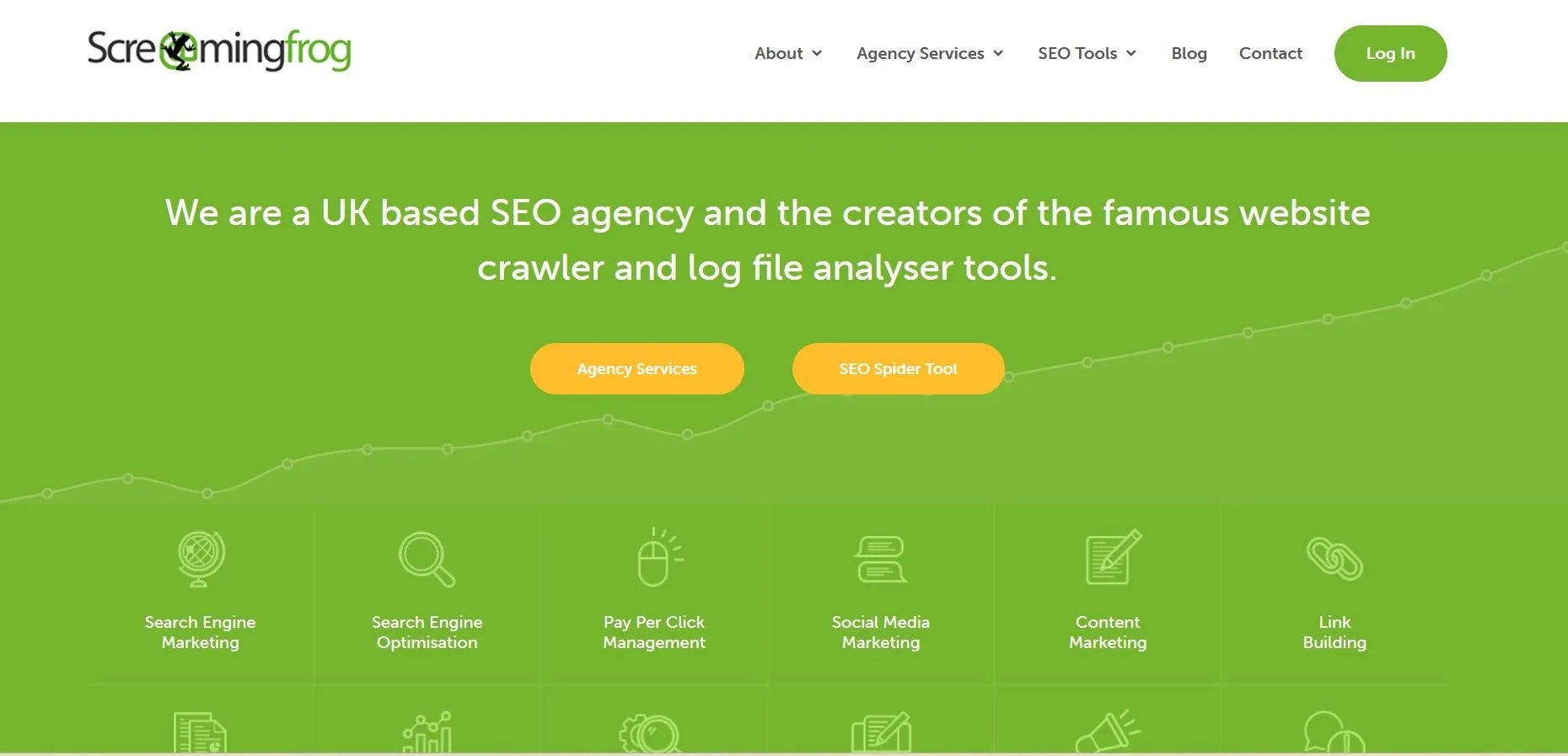
Image: Screaming Frog
Advantages and disadvantages of Screaming Frog
Using Screaming Frog has several advantages and disadvantages. Let’s discuss some of them below:
Advantages of Screaming Frog
- Comprehensive website crawling
- Seamless integration with Google Analytics, Google Search Console, PageSpeed Insights, and many others.
- Detailed SEO reports with customizable crawls
- A great tool for technical SEO audits
- Affordable compared to other technical SEO solution providers.
Disadvantages of Screaming Frog
- Limited off-page SEO features
- This is not a cloud-based solution and therefore runs on your local machine.
- It takes some time to learn how to use the tool effectively.
How much does the business SEO tool Screaming Frog cost?
Screaming Frog has excellent pricing that suits both small teams and large companies. If your team consists of up to 4 members, the cost per license will be $249 per year. If you have more than 20 team members, the annual cost per license is reduced to $225. To learn more about pricing, please visit Screaming Frog.
6. BrightEdge
BrightEdge is somewhat underrated, but it can be very useful for enterprise-level SEO audits. The tool can provide real-time insights and monitor changes in search engine performance, allowing us to make necessary adjustments immediately. Search intent analysis, SEO Opportunity Advisor, Copilot Content Advisor, and Autopilot Artificial Intelligence (AI) support are some of its well-known features for enterprise SEO.
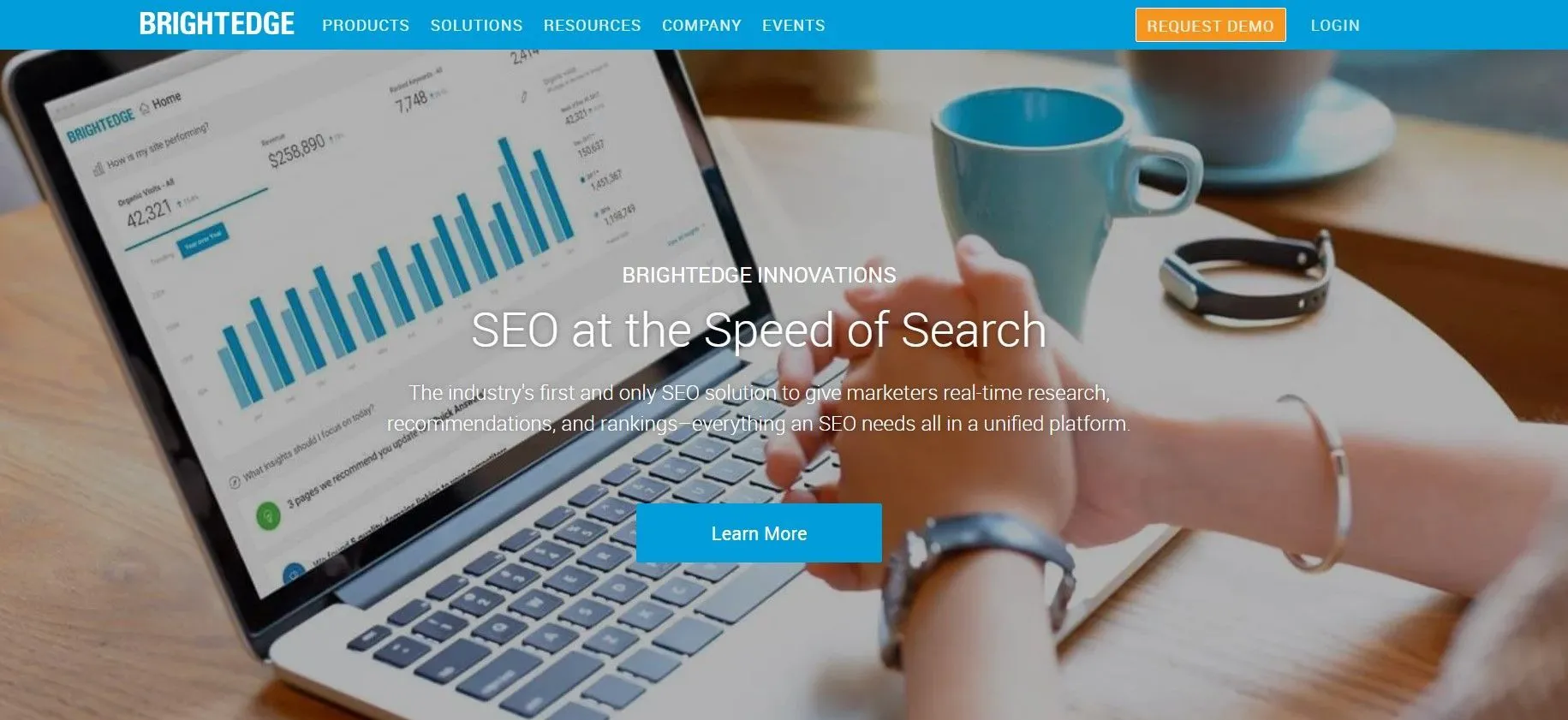
Image: BrightEdge
Advantages and disadvantages of BrightEdge
Using BrightEdge has several advantages and disadvantages. Below, we’ll take a closer look at some of them:
Advantages of BrightEdge:
- An all-in-one SEO tool
- Integrated with Google Analytics and Adobe Analytics, providing a unified view of performance metrics
- Dedicated support team
- Designed and developed for enterprise customers
Disadvantages of BrightEdge
- Very expensive
- It takes some time to learn how to use the tool
- The reports it generates are sometimes below average.
How much does the SEO tool BrightEdge cost for businesses?
BrightEdge’s pricing is somewhat of a mystery box and can vary from customer to customer. Our research indicates that the annual cost after the demo ranges from $75,000 to $100,000. If you think you need BrightEdge, you should expect a bargain, as they offer a significant discount later. Read this Reddit post to learn more about their pricing.
By the way, if you’d like to request a demo and learn more about their pricing options, contact BrightEdge.
7. Botify
Botify positions itself as an enterprise-focused SEO tool that can help large companies improve their SERP rankings using the power of generative AI. The tool promises to optimize content for search engine platforms like SearchGPT, leading to increased visibility. It can also be used to identify indexing and crawl efficiency issues, which is particularly important for high-traffic websites that require maximum accessibility for search engines.